Refrigerators under attack: how Neti could have prevented a crisis like the one in French supermarkets
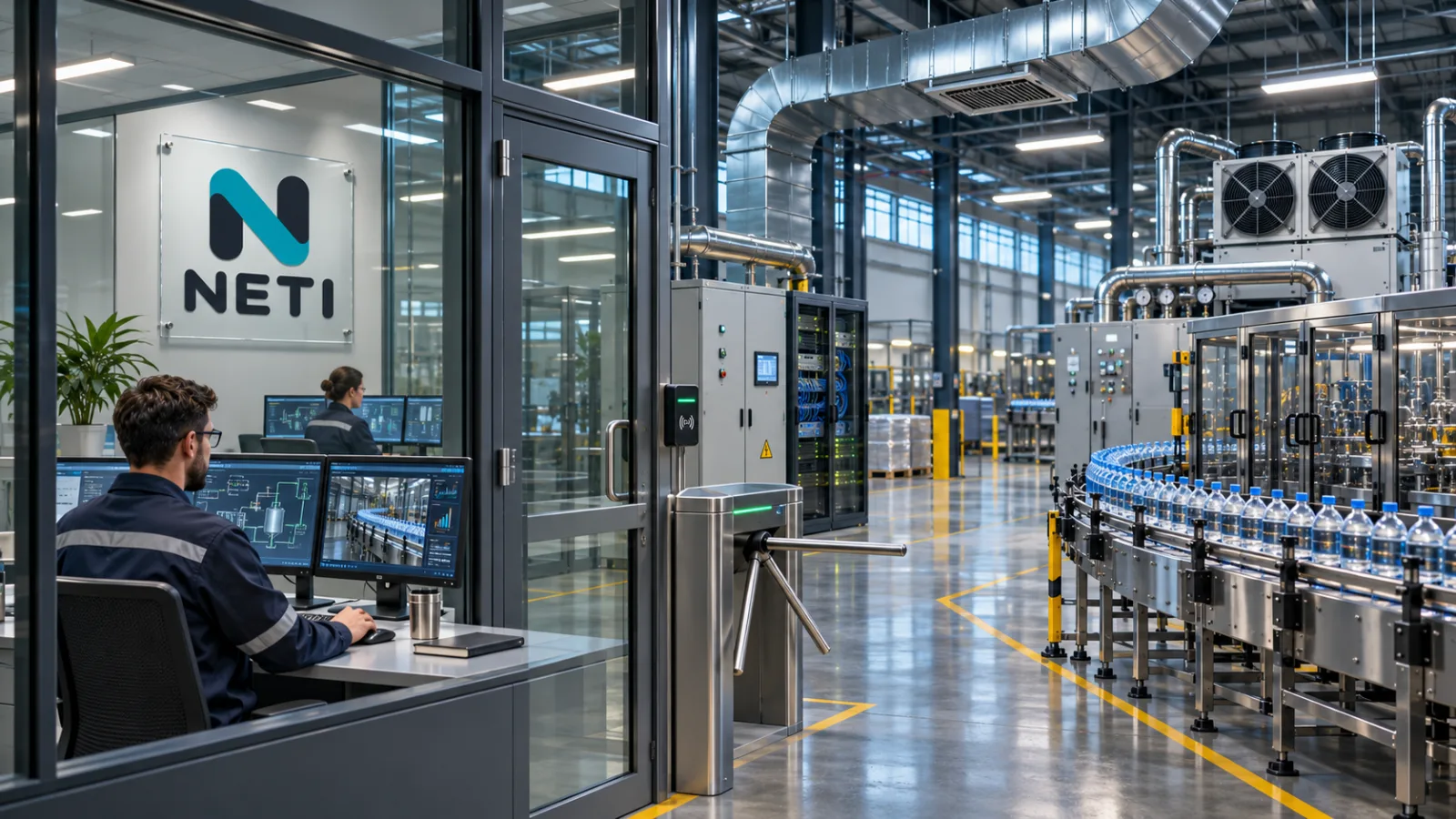
700 supermarkets hit, refrigeration systems manipulated remotely and tonnes of food spoiled. The October 2026 cyberattack in France shows how dangerous it can be to leave industrial systems reachable from the Internet. Zero Trust protection such as Neti could have cut off one of the main access routes, without replacing existing machinery.
When a cyberattack becomes a physical problem
During the night of 11 to 12 October 2026, around 700 French supermarkets were caught up in a campaign of cyberattacks against refrigeration systems. During the night of 1 to 2 November a second wave followed which, according to Unit 42, hit more than a hundred stores in at least ten other European countries.
The attackers managed to gain remote access to commercial refrigeration control systems and altered essential operating parameters.
In several cases they tampered with defrost cycles, which are normally used to remove ice from the equipment. Temperatures were pushed as high as 50 °C, causing goods to spoil, disrupting operations and, in some cases, starting small fires.
France's CERT-FR identified compromises affecting Danfoss controllers in the AK-SM and AK-SC series, as well as Copeland xweb and Dixell xweb systems.
This story concerns far more than supermarkets. The same attack principle can affect factories, cold storage warehouses, air conditioning plants, HVAC systems, food production sites and other remotely managed infrastructure.
The problem is not just the vulnerability of an individual device. It is the possibility for an unauthorised party to reach, over the Internet, a system capable of changing a physical process.
The technical problem: an industrial controller accessible from outside
A modern refrigeration system uses electronic controllers and supervisory systems to regulate temperatures, compressors, alarms and defrost cycles.
To allow technical support, some of these devices provide web interfaces that can be accessed remotely.
This feature is useful: a maintenance technician can intervene without physically travelling to the supermarket or the plant.
The risk arises when the controller is directly exposed to the Internet through a public IP address and a port forwarding rule on the router.
In a vulnerable configuration, the path can be extremely simple:
Internet → Router with open port → Controller interface → System parameters
An attacker can find the interface by scanning the Internet and, if there are weak credentials, misconfigurations or firmware vulnerabilities, try to take control of the device.
Once they have acquired the necessary privileges, they could change temperature setpoints, operating modes and defrost schedules.
The key point is that the attacker does not necessarily need to install sophisticated malware. If they manage to log in as an administrator, they can use the controller's normal functions to issue harmful commands.
In the French case, the initial access methods have not been publicly confirmed: Unit 42 also writes that the initial vector remains unconfirmed. However, exposing management systems to the Internet is one of the main risks highlighted by the authorities.
How Neti would have changed the access architecture
Neti is the access protection system we built at LaloSpace on the Zero Trust model. We designed it to place a layer of control in front of business services and remotely reachable devices: for every request, Neti decides whom to trust.
The principle is simple: do not let just anyone on the Internet communicate directly with a critical system.
With Neti, one possible architecture for web access to a refrigeration supervisor would have been:
Technician → Neti verifies who they are and decides whether to trust them → WireGuard tunnel → Controller interface
The controller would no longer have needed a publicly accessible management port.
The supermarket's network would have established an outbound encrypted connection to Neti, via WireGuard. Remote access would have been permitted exclusively through this path.
For industrial protocols other than HTTP and HTTPS, WireGuard VPN access would instead be required, with suitably restricted network rules.
First layer: removing direct exposure
The first protection is also the most important one.
If the controller interface is not published directly on the Internet, an automated scan of the supermarket's IP address cannot reach its administration panel.
The attacker therefore cannot send authentication requests, vulnerability exploitation attempts or configuration commands directly to the controller.
Neti does not fix the vulnerability in the firmware, but it can make the vulnerable service unreachable from outside.
This is a substantial difference: a device can remain vulnerable without being directly attackable from the Internet through that specific interface.
This outcome requires precise configuration: no leftover port forwarding, no alternative unprotected access and firewall rules that allow only the intended paths.
Second layer: verifying who is accessing
Suppose an attacker knows the address the technicians use to manage the systems.
In a traditional setup, they might find themselves straight in front of the controller's login page, possibly protected by outdated authentication.
With Neti, they would first encounter a separate layer of access control.
Neti decides whom to trust by combining several signals: user authentication, two-factor verification, the origin of the request, the reputation of the address and permissions on individual services.
Anyone who fails these checks does not earn Neti's trust and is stopped before reaching the industrial device.
In this scenario, knowing the controller's address or its password would not, on its own, be enough to get past all the protections.
For an organisation with multiple suppliers, it would also be possible to manage access to protected services without indiscriminately sharing device credentials.
Third layer: recognising and limiting hostile attempts
In Neti we integrated tools such as CrowdSec, Fail2Ban, reputation checks and honeypots.
These mechanisms can hinder automated scans, repeated authentication attempts and other suspicious activity directed at the gateway.
An address identified as hostile can be blocked before it reaches the internal system.
These functions do not replace the first line of defence, namely closing off direct access, and they do not guarantee that every attack will be recognised. They do, however, add further obstacles to compromise.
Fourth layer: keeping remote access separate from physical control
Another fundamental distinction concerns how the plant operates.
Neti is not meant to replace the PLC, the refrigeration controller or the local control mechanisms.
Its job is to protect the remote access path.
Temperature regulation, interlocks and physical safeguards must continue to be handled by local systems, regardless of whether the Internet or the gateway is available.
This avoids turning information security into a new point of failure for operational continuity.
The moment the attack would have been stopped
Let us imagine one of the French supermarkets with a Neti architecture correctly implemented before the incident.
The attacker scans the Internet looking for remotely reachable refrigeration controllers.
They do not find the administration interface on the store's public address, because the service has been removed from direct exposure.
Even if they knew the address of the Neti gateway, they would have to pass identity verification and earn Neti's trust for that specific service.
Without valid access, they could not reach the interface that allows defrost cycles to be changed.
The attack chain would break before reaching the industrial controller, without any need to recognise the malicious command or to fix every vulnerability in the device in advance.
This is the scenario in which Neti could have prevented the incident: external attackers trying to exploit a directly exposed management interface who do not already have valid access to the protected environment.
This does not mean that every possible attack would have been neutralised. A compromised maintenance computer, a stolen legitimate account or an intrusion already present in the OT network require further countermeasures.
The value for factories and production environments
The same architecture can have important applications in manufacturing.
A CNC machine, a SCADA supervisor, an energy management system or an industrial air conditioning plant may have remote maintenance needs similar to those of a refrigeration controller.
In these environments it is common to find devices with outdated firmware, long life cycles and updates that are hard to apply without stopping work.
An access gateway can reduce the risk associated with external exposure, while keeping remote maintenance available for verified technicians.
For complex OT environments, network segmentation, patch management, industrial protocol monitoring, the security of technicians' workstations and independent process safety systems all remain essential.
Neti is not a substitute for these measures, but it can provide an additional barrier at the point where the outside world meets the production infrastructure.
The French authorities' recommendations confirm the need for a change of approach
After the attacks, CERT-FR published alert CERTFR-2026-ALE-012, updated several times up to 16 October.
The recommendations include removing the exposure of controllers on public IP addresses, restoring access only through secure VPNs or protected networks, reviewing configurations and updating firmware.
These measures are consistent with the problem we built Neti to solve: taking critical systems out of direct exposure and controlling remote access.
Consistency with the recommendations does not, of course, amount to certification of the product, nor to proof that Neti would have stopped the attacks that actually took place.
Conclusion: protecting machines before anyone can reach them
The attack on French supermarkets shows that industrial information security is not just about computers, files and data.
Compromised remote access can change temperatures, interrupt processes, destroy goods and cause physical consequences.
To reduce this risk, protecting a machine's password is not enough. The way that machine is reached from outside has to be rethought.
We built Neti to provide a concrete answer to this problem: removing direct access, deciding whom to trust by verifying every identity, letting through only the necessary connections and carrying traffic over protected paths.
Had such an architecture been correctly adopted in the affected supermarkets, it could have prevented the attacks based on unauthorised external access to the control panels.
The principle also applies to industry: protecting a plant means not only preventing its compromise but, above all, ensuring that a potential attacker has no way of reaching it.
Counterfactual technical analysis based on information publicly available as of 23 November 2026. It does not constitute a penetration test, a security certification of Neti or a claim that the product was in use at the affected sites.
Sources
- CERT-FR: CERTFR-2026-ALE-012, security incident affecting remote controllers of refrigeration systems (versions from 12 to 16 October 2026)
- AP: cyberattack on refrigeration systems hits 700 supermarkets, French government says (13 October 2026)
- Unit 42, Palo Alto Networks: Turning Up the Heat, Inside the Attacks on Europe's Refrigeration Systems (6 November 2026)
- Neti: technical overview and features