NVIDIA paid $12.9 billion for a "Download" button. Madness or masterstroke?
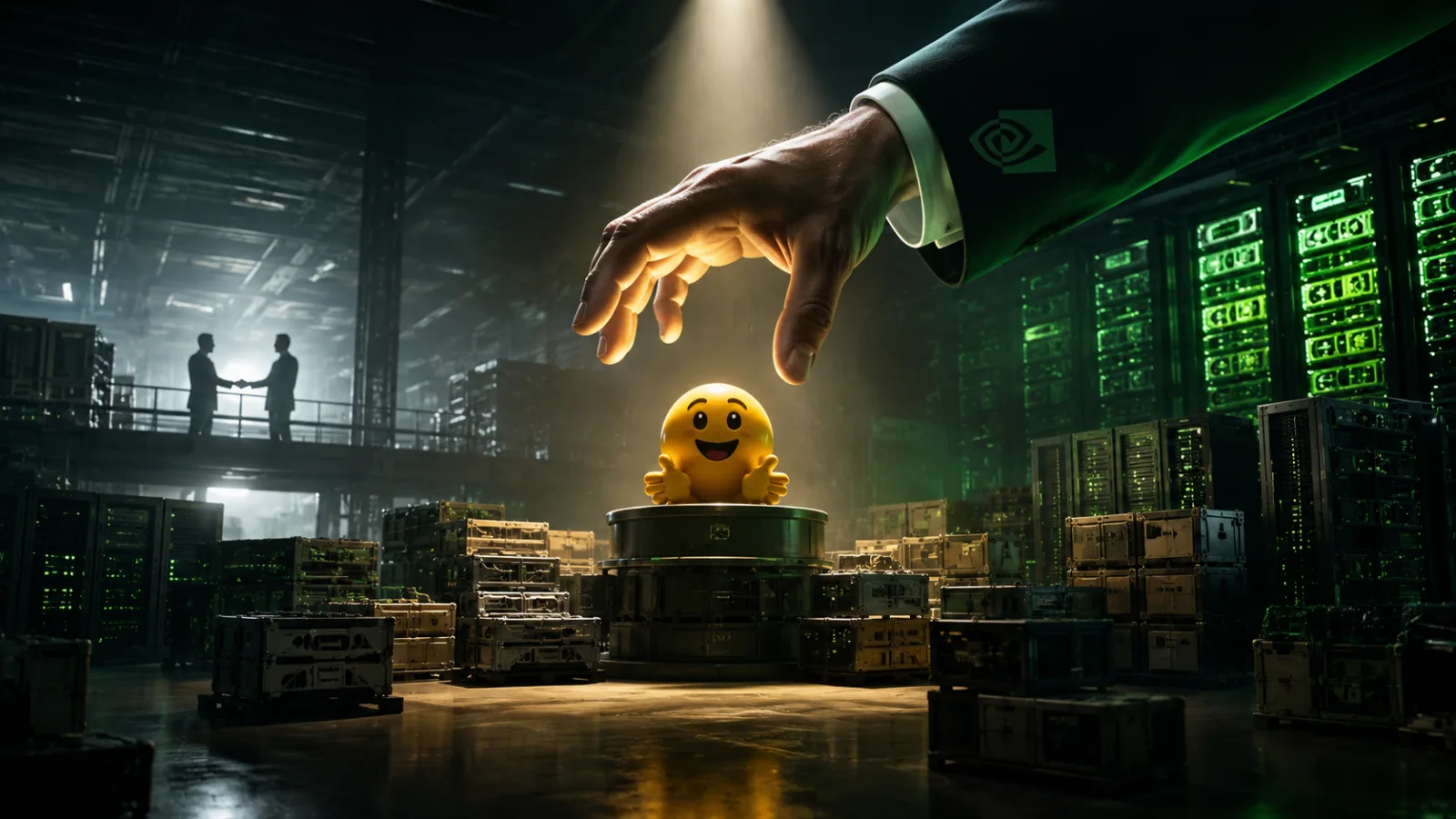
On 3 September 2026 NVIDIA announced it was buying Hugging Face for $12.9 billion. It is the second largest deal in its history, it should close in early 2027, and the leadership promised to keep the platform independent, open and neutral toward hardware.
Let us stop for a second on that figure, because it is enormous.
Twelve billion nine hundred million dollars. For a company that, in August 2026, made around 150 million dollars a year in recurring revenue.
That means NVIDIA paid Hugging Face roughly eighty-six times its annual revenue.
So it is worth asking an uncomfortable question, the one that tends to get skipped in the noise of the announcements: what did NVIDIA actually buy?
What Hugging Face is, technically
Strip away the aura and Hugging Face is a warehouse.
It is the place where the artificial intelligence community uploads and downloads models and datasets. You find the weights of open models, their descriptive cards, the datasets, and a set of conveniences built around all this: the transformers and datasets libraries, the Spaces for running small demos in a browser, and some managed hosting for those who want to put a model behind an endpoint without thinking about infrastructure.
It is extremely useful. It has become the de facto standard. But under the hood there is no miraculous, unrepeatable technology.
There is, in essence, storage for very large files, Git-style versioning, a content delivery network, a nicely made web interface and a huge community that decided to gather there. The software that really matters, the libraries, is open source: anyone can use it without going through the hub.
Put bluntly, Hugging Face is a "hug" around a Download button.
This is not an insult. Building the place where everyone agrees to meet is hard, and the value of a square is not in its bricks but in the fact that people show up. But that is exactly the point: the value of Hugging Face is not in the technology underneath, which is replicable, but in having become the default meeting place.
And a meeting place, from a technical standpoint, can be rebuilt. Winning the community is not easy, but the bricks, storage, CDN, a frontend, file versioning, are within reach of anyone with the right skills and capital. There is no secret patent that makes Hugging Face irreplaceable.
The numbers that do not add up
Let us line up the figures.
The platform reports something like thirteen million users and half a million organisations. These are significant numbers for a technical community.
The problem is how they turn into money, which is to say almost not at all.
The vast majority of people use Hugging Face for free, because its main function, downloading and uploading models, is free and has to stay free, otherwise the community goes elsewhere. Revenue comes from a much narrower slice: managed hosting on GPUs paid by the hour, Enterprise licences at around twenty dollars per user, Pro subscriptions at nine dollars. Useful, growing, but always a thin layer of monetisation sitting on top of a service that by definition gives away its own core.
The result is that a platform with millions of users makes around one hundred and fifty million dollars. Not billions. Millions.
And this is where 12.9 billion becomes hard to explain by looking at the company itself. Eighty-six times revenue for a service whose infrastructure is replicable and whose users, for the most part, pay zero. On any traditional spreadsheet, that figure is indefensible.
So if it does not make sense looking at Hugging Face, it has to make sense looking at who is buying it.
The "European startup" that was never really European
Before we get to NVIDIA, an aside that says a lot about the state of things.
Hugging Face is told as a French success story, and in part it is: it was founded by three Frenchmen and incubated in Paris. But its headquarters are in Brooklyn, its ownership and most of its investors are American, and now the company ends up inside a United States chip giant.
It is the recurring fate of "European" technology: it is born from European talent, grows with American capital, and gets absorbed once it becomes strategic. The infrastructure that a large part of open AI rests on, the warehouse of models, passes this way under the control of a single hardware vendor based in the United States. Anyone in Europe talking about digital sovereignty should look at this deal very carefully.
So why does NVIDIA pay 12.9 billion
The answer is that NVIDIA is not buying Hugging Face's revenue, and it is not buying some impossible-to-find technology. It is buying a position.
Hugging Face is the funnel through which the distribution of open models passes. It is the first place a developer lands when looking for a model, the default you download from, try out, put into production. Whoever controls that funnel controls the point where the world of open AI meets the hardware the models then run on.
And this is NVIDIA's real game. Not the hub in itself, but the fact that the hub is the doorway to inference, that is, the moment when a model, after being trained, is actually executed to answer requests. Training has so far been the great GPU market. Inference will, in all likelihood, be an even bigger one, because a model is trained once and then executed billions of times.
By buying the warehouse of models, NVIDIA places itself at the exact point where it is decided where and how those models will be run. It can steer, gently or otherwise, the entire ecosystem toward its own stack. It can defend itself from anyone who would make inference independent of a single vendor's hardware. And it can make sure the square where models and developers meet does not end up in a competitor's hands.
Seen this way, 12.9 billion is not the price of Hugging Face. It is the price of not letting someone else buy Hugging Face, and of guarding the entrance to a far larger market.
The bet on local inference, which I share
There is a part of this story worth being explicit about, because it is the reason the deal, for all its disproportion, is not stupid at all.
The future of inference is not only in the big data centres. A growing share will move toward local execution: models that run on the laptop, on the company server, on the device, without sending data to an external service. It is a direction I have defended for a long time, for reasons of privacy, cost, latency and control. A model that runs at home sends your data to no one, does not depend on the connection, and does not hand you a metered bill that grows without limit.
NVIDIA knows this, and it knows that local inference needs two things: hardware able to run models close to the user, and a place to get those models from. NVIDIA already has the hardware. With Hugging Face it also takes the second piece, the source from which the models are distributed.
On this the logic is flawless. The problem remains the figure.
Because it is one thing to recognise that inference, local and otherwise, will be the real market of the coming years. It is another to pay thirteen billion for a warehouse of files that anyone, technically, could rebuild, and whose only real defence is the community's habit of passing through it.
What this price really tells us
The purchase of Hugging Face is one of those moments when the market stops pricing technology and starts pricing position.
You are not buying revenue. You are not buying a patent. You are buying control of a chokepoint, the fear that someone else takes it, and a bet on where value will move in the coming years.
It may be that, ten years from now, this move is remembered as brilliant, because it handed NVIDIA the guardianship of the entire open AI ecosystem right as inference exploded. Or it will be remembered as one of the most inflated prices of a season in which writing "AI" next to a name was enough to multiply its value.
What is certain already today is that 12.9 billion does not measure the technology underneath Hugging Face, because underneath Hugging Face there is no thirteen-billion-dollar technology.
It measures how much it is worth, for the one who sells the shovels, to own the map of the mine as well.