EssilorLuxottica won the first smart glasses battle... but it risks remaining just the frame around someone else's computer

This article carries weight, and it matters a great deal to me.
The company I am about to write about was born right here, where I live. It is the company that built much of what surrounds me every day.
But that is exactly why I will not go easy on anyone. I want to give my own point of view, all the way.
Ray-Ban Meta solved the problem Google Glass never managed to solve: convincing millions of people to wear a computer on their face. But while EssilorLuxottica and Meta keep refining that formula, ultralight displays, local AI and new low-bit models are rewriting the rules once again. The next battle will not be about selling more glasses. It will be about deciding who owns the interface through which we see the world.
There are moments when the biggest risk for a market leader is not making a mistake.
It is continuing to do perfectly what made it the leader, while the very nature of the market changes.
EssilorLuxottica and Meta have achieved something many tech giants failed at before them: they turned smart glasses from a socially awkward gadget into a product millions of people are willing to wear every day.
That is no small result.
It is probably the most important result the augmented reality industry has achieved so far.
In the second quarter of 2026, according to IDC, Meta held 68.7% of global XR headset and glasses shipments. Glasses without a display (“audio glasses” in IDC’s classification, a category dominated by Ray-Ban Meta) accounted on their own for 70.3% of units shipped. At the same time, EssilorLuxottica reported that revenue from AI glasses had almost doubled in the quarter.
These are leadership numbers.
And that is exactly why the problem now emerging deserves attention.
Because EssilorLuxottica and Meta may have won the first smart glasses battle by building the best smart eyewear on the market.
The second battle, however, will be about building something different:
the first true personal computer you wear on your face.
And it is far from certain that the skills needed to win the first are enough to win the second.
EssilorLuxottica’s masterpiece is not technological. It is anthropological.
To understand where things stand, you have to fully acknowledge what EssilorLuxottica brought to the partnership with Meta.
Not just Ray-Ban.
Not just lenses.
It brought knowledge that is extremely hard to replicate: how to get a person to accept wearing an object on their face ten hours a day.
Fit, ergonomics, weight, prescription, materials, optical retail, adjustments, service, aesthetics, brand identity.
An electronics company can design an incredibly powerful computer.
Building something a human being actually wants to put on their face is a completely different problem.
Meta and EssilorLuxottica have worked together since 2019, and in 2024 they extended the agreement on a multi-year horizon reaching into the next decade. The stated logic of the partnership is precisely to combine Meta’s technology with EssilorLuxottica’s manufacturing, distribution and design capabilities.
That formula worked.
Ray-Ban Meta Gen 3 now packs a 12 MP camera, 3K video, six microphones and up to nine hours of battery life, while still looking essentially like a pair of Ray-Bans.
It is a remarkable feat of industrial packaging.
But it also carries the seed of the problem.
Because the whole architecture has been optimized around one principle:
technology must disappear inside the eyewear.
The next generation may require exactly the opposite:
the eyewear must become technology.
The golden cage of Ray-Ban Meta
The classic Ray-Ban Meta has eyes (the camera) and ears (microphones and speakers).
It can observe the world.
It can listen.
It can query an artificial intelligence.
It can answer.
But one fundamental channel is still missing:
it cannot show the digital world directly in the user’s field of view.
The interaction is still basically:
world → camera → AI → audio.
It is surprisingly useful.
But audio carries radically less information than sight.
An assistant can say:
“In a hundred meters, turn right.”
A display can simply show an arrow.
An assistant can read out a translation.
A display can overlay subtitles while you keep looking at the person who is talking.
An assistant can describe an industrial component.
A display can point straight at the screw to remove.
It is the difference between an assistant that knows what you are looking at and a computer that truly shares your visual space.
Meta knows this difference perfectly well.
That is why Meta Ray-Ban Display exists.
And it is precisely that product that shows how hard it is to break through the next barrier.
Ray-Ban Display integrates a 600×600 pixel color panel with a field of view of about 20 degrees, but on one eye only. Weight rises to about 69 grams, compared with the much more conventional eyewear territory of the display-less versions.
In exchange you get heads-up navigation, messages, visual information, images and interaction with Meta AI without pulling out your phone.
It is an important step forward.
But it exposes the triangle nobody in the industry has fully solved yet:
aesthetics, battery life, visual computing.
Improving one of the three still costs something on the other two.
Then you look at China, and the picture becomes less reassuring
Saying that “the Chinese have overtaken Meta” would be wrong.
Commercially it is not even close.
Meta holds almost 69% of the global market, while RayNeo, Xiaomi and other competitors remain at a few percentage points.
But looking only at market share means looking in the rearview mirror.
The interesting question is a different one:
how fast is the technical frontier moving?
Rokid today sells smart glasses weighing about 49 grams with a binocular MicroLED display (monochrome), a 30 degree field of view, a 12 MP camera, Snapdragon AR1, 2 GB of RAM, 32 GB of storage, navigation, translation, teleprompter and an SDK.
They do not necessarily have Ray-Ban’s optical, industrial, retail and brand refinement.
That does not make them a better product overall.
But one figure should catch the attention of any R&D lead in the industry:
49 grams. Binocular display.
Meta Ray-Ban Display is around 69 grams and monocular.
RayNeo, at the most technological end, offers the X3 Pro with a full-color binocular MicroLED, 640×480, a 30 degree field of view, 4 GB of RAM, Snapdragon AR1, 6DoF and SLAM. It weighs 76 grams, so it clearly loses on elegance and comfort, but it already shows the other possible direction: not eyewear with a few digital features, but a small programmable AR computer.
That is the signal that matters.
China has not yet beaten EssilorLuxottica on product.
But it is exploring the design space far more aggressively.
And when ten companies are simultaneously trying different combinations of MicroLED, waveguides, batteries, AI models, sensors and operating systems, what matters is not which product is best today.
What matters is how fast the curve converges.
The mistake would be to think the next barrier is only optical
EssilorLuxottica seems fully aware of the strategic importance of the display.
In June 2026 it signed a long-term joint development agreement with Applied Materials on next-generation optical technologies, including waveguides, advanced materials and adaptive lenses. The stated goal is to speed up the commercialization of optical systems for AR smart eyewear on scalable platforms.
It is an extremely important move.
But it may not be enough.
Because while the optical problem is being solved from one side, something potentially even more disruptive is happening on the other.
Artificial intelligence is leaving the cloud.
The next leap will not be a better display. It will be a local brain.
First-generation smart glasses depend heavily on a combination of glasses, smartphone, connectivity and cloud.
That model makes sense when large AI models need tens of gigabytes of memory and data centers full of GPUs.
But that assumption is starting to break.
At Snapdragon Summit in September 2026, PrismML showed a new multimodal Bonsai model of about 2 billion parameters running locally on smart glasses equipped with Snapdragon AR1 Gen 1.
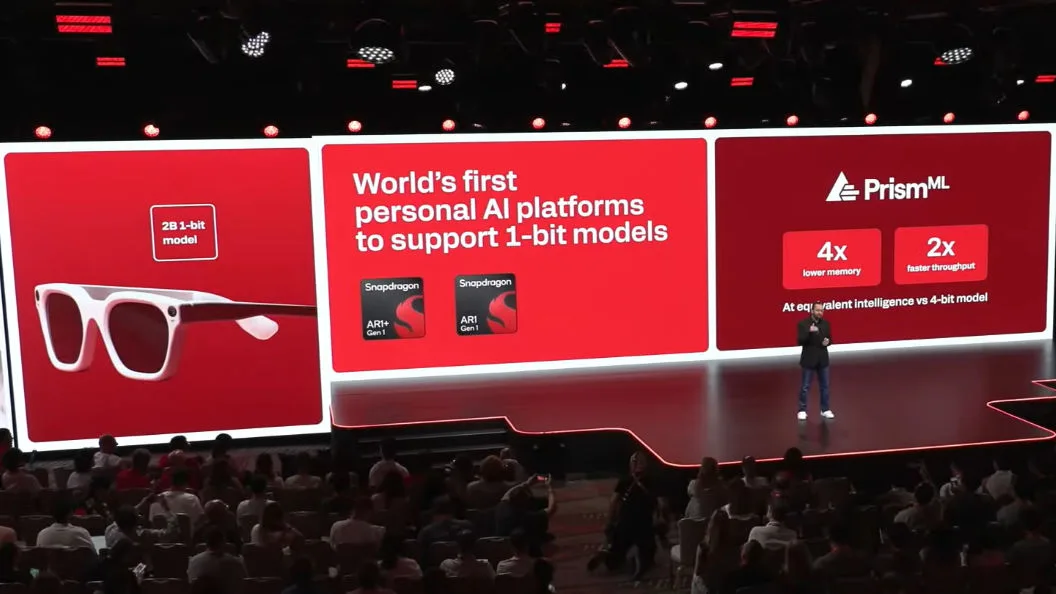
The technology uses an extremely low-bit representation; according to PrismML, the same memory budget can now host models with about four times as many parameters as earlier conventional configurations.
Some caution is needed.
A 2 billion parameter model does not replace a frontier model in the cloud.
And “1-bit” does not mean the whole system (activations, KV cache, vision encoder, scratch memory) runs on a single bit.
But the strategic point stands.
A local model does not have to replace the cloud.
It has to remove from the cloud everything that should never have been there in the first place.
OCR.
Object recognition.
Scene understanding.
Basic translation.
Command interpretation.
Classification.
Local contextual memory.
Small reasoning tasks.
Filtering the events that matter.
The architecture becomes:
camera → local AI → answer
and only when needed:
local AI → larger model in the cloud.
That difference changes battery life, latency, infrastructure costs and above all privacy.
And it also changes the competitive structure of the industry.
Why this technology should worry Meta more than EssilorLuxottica, and interest EssilorLuxottica more than anyone else
Today a substantial part of the value of AI glasses comes from the intelligence Meta can deliver through its own infrastructure.
If local intelligence improves quickly, that component becomes more and more interchangeable.
The same Snapdragon AR1 that powers a large part of the category is available to many manufacturers. Qualcomm designed it specifically for smart glasses, and it explicitly supports on-device AI and binocular displays. In September 2026 Qualcomm also launched Snapdragon START, a turnkey program that lets more and more companies build Personal AI devices starting from hardware, software and manufacturing partners that are already integrated.
In other words:
the technological barrier to entry is coming down.
Sony camera.
Snapdragon.
MicroLED.
Waveguide.
A Qwen, Gemini or ChatGPT model, or a low-bit VLM.
Pre-assembled software.
A manufacturer that five years ago would have had to build an XR lab can now buy a growing share of the stack.
What remains much harder to buy?
The relationship between a lens and the human face.
Prescription.
Optical manufacturing.
Fitting.
Distribution.
Brand.
The ability to produce hundreds of variants that genuinely look like eyewear.
That is where EssilorLuxottica stands.
And that is exactly where the paradox shows up.
EssilorLuxottica may own the hardest asset to replicate. But it does not own the platform yet.
The smartphone world taught us a lesson.
The maker of the most important physical component does not necessarily capture most of the value.
Value tends to accumulate around whoever controls:
operating system, identity, applications, data, services and the digital relationship with the user.
In smart glasses the strategic question is therefore very simple.
When a person wears an EssilorLuxottica device ten hours a day, whose experience will it be?
The eyewear’s?
Meta’s?
Android XR’s?
Gemini’s?
Qwen’s?
The chipmaker’s?
The AI agent’s?
The app they are using?
It is a far more important question than the resolution of the next display.
Because a company can become the world’s largest maker of AI glasses and at the same time not own the layer where future economic value concentrates.
That is the risk.
Not losing to Rokid.
Not losing to Xiaomi.
The most dangerous signal from Chinese competition is not price
It is philosophy.
Many Western manufacturers keep asking themselves:
“How much technology can we add without compromising the eyewear?”
Part of the Chinese ecosystem seems to be asking:
“How much computer can we squeeze into fifty grams?”
They sound like almost identical questions.
They are not.
The first starts from the eyewear industry.
The second starts from computing.
In the long run they could lead to completely different products.
And the arrival of local AI suddenly makes the second path much more viable.
The interface of the future will probably not be a smaller smartphone
There is a conceptual mistake that has followed AR for fifteen years: imagining glasses as a phone moved in front of your eyes, with menus, windows, apps, icons and virtual screens.
Artificial intelligence changes that logic. Truly mature smart glasses may have very little traditional graphical interface, because their job will be a different one: to understand, continuously, what I am looking at, what I am doing and what would be useful for me to know right now.
The display will not need to fill the field of view. It may be enough for it to show the right thing for three seconds: an arrow, a name, a translation, a value, a warning, the next thing to do.
That is a very different category from the AR imagined in the HoloLens days. You do not necessarily need a huge field of view; you need something much harder, namely an intelligence that keeps following the context, with near-zero friction.
At that point glasses stop being a peripheral and become the device that best knows the physical context of whoever is wearing them. The smartphone knows where we are, the watch knows what our body is doing; glasses can know what we are seeing. And that information is enormously valuable.
The lens stops being just optics
For more than a century the lens has had a single job: correcting light before it reaches the eye.
In the coming years it will have to host much more. In and around the lens will go the waveguides that carry the image to the eye, the display, the sensors, eye tracking, dynamic vision correction, lenses that darken on electronic command. The lens will no longer be the transparent part covering the technology: it will become part of the technology itself.
And this is probably where EssilorLuxottica holds a card that Meta, Google, Apple, Alibaba and Xiaomi do not hold in the same form. It can turn a skill seen as traditional, optics, into the proprietary component on which the next generation of devices will be built.
But it has to do it before the architectures get standardized somewhere else.
You do not need to beat the Chinese. You need to stop them from setting the rules of the new category.
Rokid today is tiny compared with Meta.
RayNeo is tiny.
Xiaomi has a limited share.
Alibaba is building its own ecosystem.
Taken individually, none of them is a threat today to Ray-Ban Meta’s commercial leadership.
But that is not the right reading.
The threat is the collective speed of exploration.
Ten companies trying ten different architectures every twelve months can find combinations faster than a leader, understandably busy protecting a billion-dollar franchise, would be willing to experiment with.
It is the classic advantage of the challenger.
It has nothing to protect.
The leader does.
And this is where success can become a trap
Ray-Ban Meta proved that people want smart glasses that look like glasses.
But it would be dangerous to turn that truth into a dogma:
the smart glasses of the future must keep behaving like today’s Ray-Ban Meta.
The exact opposite could happen.
Technology could reach a point where displays, local AI and sensors become small enough that the compromise is no longer needed.
At that moment there will no longer be a choice between:
beautiful eyewear
and
a powerful computer.
The winning product will be both.
And when that point arrives, the market could shift much faster than current market shares suggest.
EssilorLuxottica’s advantage is that it is not too late. Far from it.
Almost no one else has, all at once:
globally desired brands, physical retail, prescription, optical know-how, manufacturing capacity, a relationship with millions of eyewear wearers and privileged access to one of the best technology partners in the world.
That is an extraordinary position.
But it opens two very different futures.
In the first, EssilorLuxottica becomes the indispensable partner that lets the big tech platforms put their computers on people’s faces.
That is already a huge business.
In the second, it becomes one of the owners of the personal visual computing platform itself.
The gap between the two scenarios could be worth far more than today’s eyewear market.
The question I would put to EssilorLuxottica’s board today
It would not be:
“How do we make better smart glasses?”
Nor:
“How do we beat Rokid, Xiaomi or Alibaba?”
Nor even:
“How do we fit a better display into Ray-Bans?”
The question would be this:
When glasses become the main device through which an artificial intelligence understands a person’s physical world, which part of that relationship will belong to EssilorLuxottica?
If the answer is only:
frame, lens, manufacturing and distribution,
then the company could become enormously bigger while, at the same time, losing relative importance in the value chain.
If instead the answer includes:
computational optics, local intelligence, platform, privacy, developers and ownership of the experience, then EssilorLuxottica is not simply entering the technology market.
It is entering one of the very few markets potentially large enough to succeed the smartphone.
And there is a reason this opportunity should be taken extremely seriously.
Apple owns the pocket.
Google owns a huge part of access to information.
Meta owns the social graph.
Microsoft owns the professional desktop.
Amazon owns a significant part of digital commerce.
Nobody owns the face yet.
EssilorLuxottica, in a sense, already starts from there.
The question is whether it intends just to dress it.
Or to build what comes after the smartphone.
Sources
- IDC: Smart Glasses Growth Cools to 35% as Meta Doubles Down on Distribution (Q2 2026)
- EssilorLuxottica: Q2 and H1 2026 results
- EssilorLuxottica and Meta announce long-term partnership (2024)
- Engadget: everything announced at Meta Connect 2026
- UploadVR: Meta Ray-Ban Display, official specs
- Rokid Glasses, product page
- RayNeo X3 Pro, product page
- Applied Materials and EssilorLuxottica join forces on AR optics (June 2026)
- TechCrunch: PrismML brings its tiny LLMs to Qualcomm-powered smart glasses
- Qualcomm Snapdragon AR1 Gen 1
- Snapdragon START, Qualcomm’s turnkey program for Personal AI devices
- Alizila: Alibaba launches Quark AI glasses deeply integrated with Qwen