The water "consumed" by datacenters does not disappear. But the problem remains.
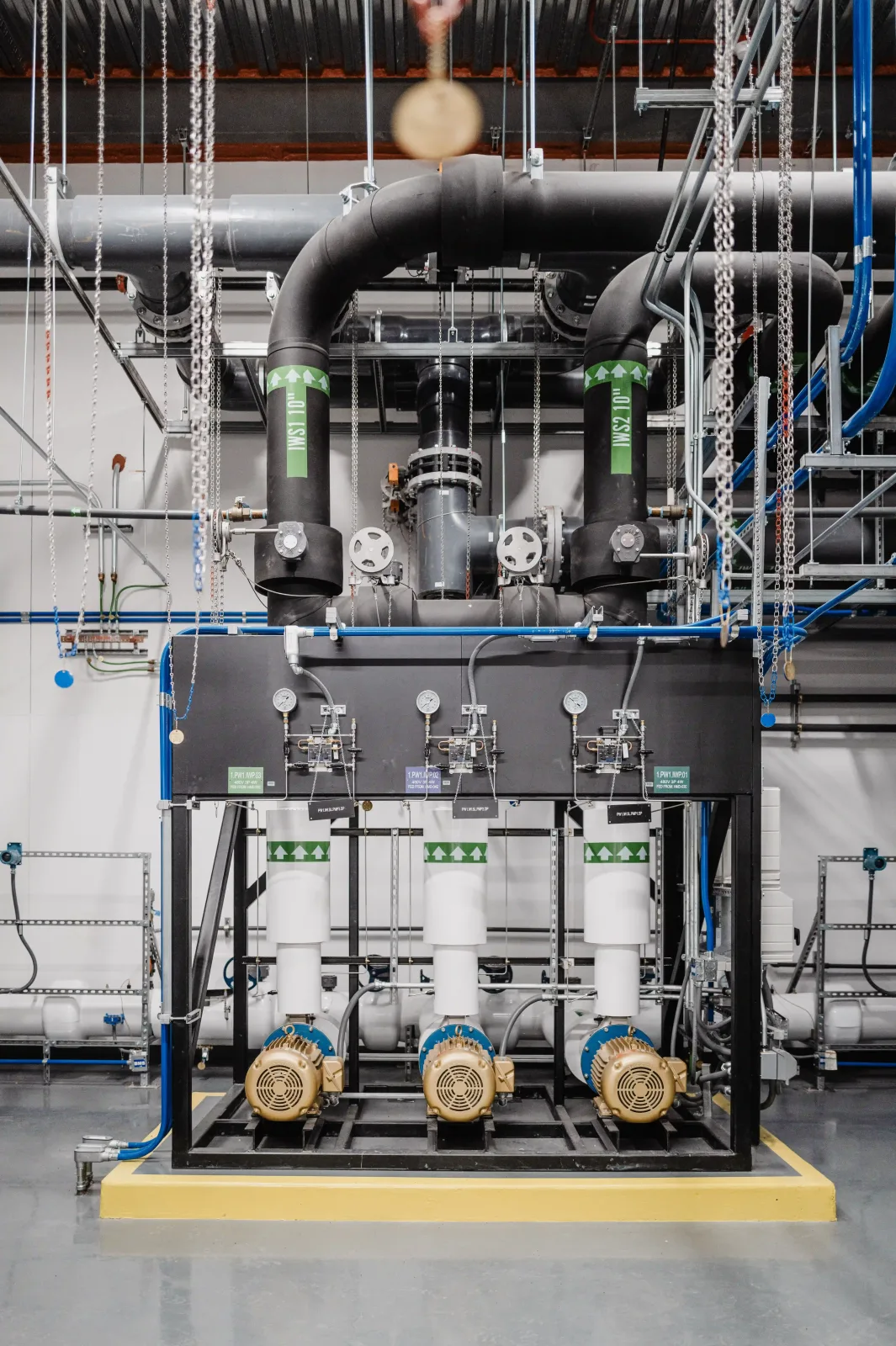
Every time the conversation turns to datacenters, artificial intelligence and sustainability, one phrase keeps coming back that sounds almost absurd: "datacenters consume water".
At first glance it seems like a stretch. The water used to cool the servers is not destroyed, and if it serves to dissipate heat, sooner or later it will return to the environment. So why call it "consumption"?
The word is technically correct but imperfect in how it communicates. The point is not that the water disappears from the planet, but where it returns, when it returns and in what condition it returns.
The flaw in the word "consumption"
In everyday language, "to consume" means to use something up until it runs out. Applied to water, the word creates a short circuit: water is not eliminated, it evaporates and reenters the hydrological cycle.
In environmental accounting, however, "consumption" has a precise meaning and must be distinguished from "withdrawal":
- Withdrawal: how much water is taken from a source (mains supply, river, aquifer, treated wastewater).
- Consumption: how much of that water does not return immediately available to the same basin, because it evaporates, is incorporated into a process or requires treatment before reuse.
A datacenter can therefore "consume" water even if, on a planetary scale, that water does not disappear: if it is drawn from a local aquifer and released into the atmosphere as vapor, it is no longer available there, at that moment, for that ecosystem or that community. The problem is local before it is global.
Why datacenters need to be cooled
A datacenter is a large concentration of computers: servers, GPUs, network and storage absorb electricity and turn almost all of it into heat. That heat must be removed continuously, otherwise the machines lose efficiency, break down or shut off to protect themselves.
So it is also a thermal machine, designed to move heat from the inside to the outside. Water comes into play because it carries heat very effectively: water cooling often reduces electricity use compared with air only cooling, but in exchange it increases direct water withdrawal and consumption.
How it works, in brief
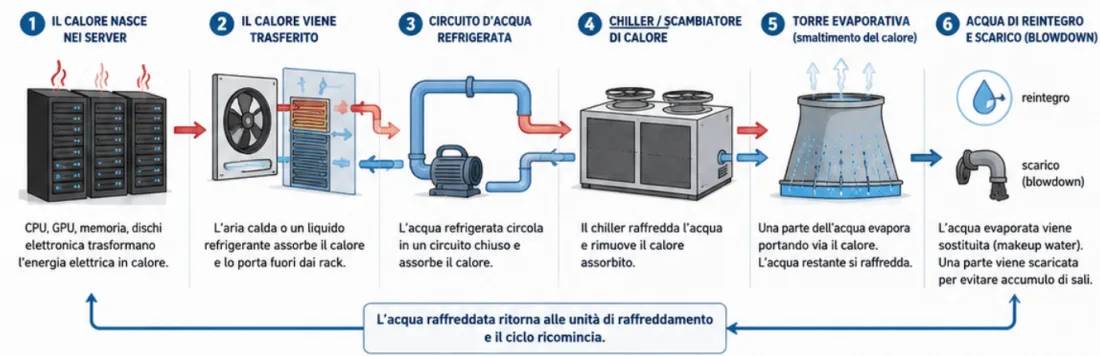
The path of the heat, simplified, is a chain:
- It is born in the chips. CPUs, GPUs and memory generate heat, released to the air (fans and heatsinks) or, in the denser systems built for AI, directly to a liquid through cold plates.
- It leaves the racks. In classic cooling the hot air from the "hot aisles" gives up heat to coils carrying chilled water; in liquid cooling the liquid works close to the chips, avoiding the need to move large volumes of air.
- It circulates in a loop of chilled water, often closed: it absorbs heat from the rooms and carries it to the chillers. A closed loop loses little water, but this still says nothing about how the heat is disposed of outside.
- It is expelled by a chiller or a heat exchanger. The heat has to be dumped outside one way or another: either to the air with "dry" systems (more electricity, little water), or toward a cooling tower (less electricity, more water). This is the central trade off.
- The evaporative tower is the core of the "consumption": the hot water flows down in contact with the air, a small part evaporates carrying away a lot of heat, the rest cools down and recirculates. The evaporated water goes into the atmosphere: it is still water, but it is no longer available locally.
- Makeup water. What evaporates has to be replaced, and the source matters: using drinking water in a water stressed area is very different from using treated wastewater. This is why aggregate numbers say little: a million liters in a water rich zone does not weigh the same as in an arid one.
- Blowdown. As pure water evaporates, salts and impurities concentrate in the loop; a share has to be discharged and replaced. It is not "lost" forever, but it may require treatment and management as wastewater.
In short: the problem is not the disappearance of the water, but its availability, quality and location.
Closed, open, hybrid
- Closed. The liquid recirculates in a sealed loop and greatly reduces operational consumption. Several new AI campuses adopt the closed loop precisely to limit evaporation; but "closed" does not mean "zero impact": the energy (and the indirect water) needed to dispose of the heat still remains.
- Open evaporative. Efficient in energy terms, but they consume water in the local hydrological sense: electrical efficiency is paid for with more water.
- Hybrid. They alternate air, evaporation and liquid according to climate, energy cost, water availability and rack density.
There is no single answer: a good system in Sweden may not be one in Arizona; one fed by available wastewater may be questionable where aquifers are overexploited.
WUE does not tell the whole story
For water efficiency people use the WUE (Water Usage Effectiveness), which relates cooling water to the energy consumed by IT. It is useful but partial: a low WUE does not say what kind of water was used (drinking or waste), in which basin, in which season, nor how much water was needed indirectly to produce the electricity.
The distinction between direct consumption (cooling) and indirect consumption (power generation) is decisive: an air cooled datacenter may declare low direct consumption and still have a significant indirect water footprint, if the electricity comes from thirsty thermoelectric sources.
Why the messaging is fragile
The debate swings between two opposing oversimplifications: "they consume billions of liters" (as if the water disappeared) and "the water does not disappear, it returns to the cycle" (minimizing the local problem). Both are partial.
The correct formulation is longer but more precise: datacenters withdraw water from local sources and, in certain systems, consume part of it because it evaporates or is made temporarily unavailable in the same basin. Without distinguishing withdrawal, consumption, evaporation, discharge, reuse and source, confusion sets in. And confusion hurts both the critic (who seems alarmist) and the defender (who seems evasive).
The real point: water is local
On a global scale water reenters the cycle; on a local scale a withdrawal has real effects. Drawing treated wastewater in a humid area is not the same as drawing aquifer water in an arid zone during a drought, in competition with agricultural and civil uses.
This is why it is not enough to ask "how much water does a datacenter consume?", but rather: where does it come from, is it drinking water or recycled, how much of it evaporates, how much is discharged and where, in which season, what is the state of the water basin and how much indirect water is tied to the energy used.
Conclusion: it is not a lie, it is an incomplete word
Saying that a datacenter "consumes water" is not false: it is false only if understood as "the water disappears from the planet", and it is correct if understood as "part of the withdrawn water does not return immediately available in the same place, state and moment".
Perhaps we should talk less about generic "water consumption" and more about local withdrawal, evaporation, discharge, reuse and availability within the basin. Because the sustainability of datacenters is not measured only in liters, but in the relationship between technology, territory and shared resources.
Water does not disappear, but it can disappear from the place where it is needed, and it can be polluted.