Data centers and the land around them: what we actually know about the impacts
When we think about the Internet, the cloud or artificial intelligence, we tend to imagine something immaterial. In reality, behind every digital service there is a physical infrastructure made of buildings, servers, transformers, cooling systems, emergency generators, power lines and large amounts of energy. Data centers are therefore industrial infrastructure in every sense, and as their size grows so does the scientific interest in what happens beyond the perimeter of the facility.
The question becomes particularly important when a data center is built near homes, farmland or natural ecosystems: up to what distance have effects actually been observed?
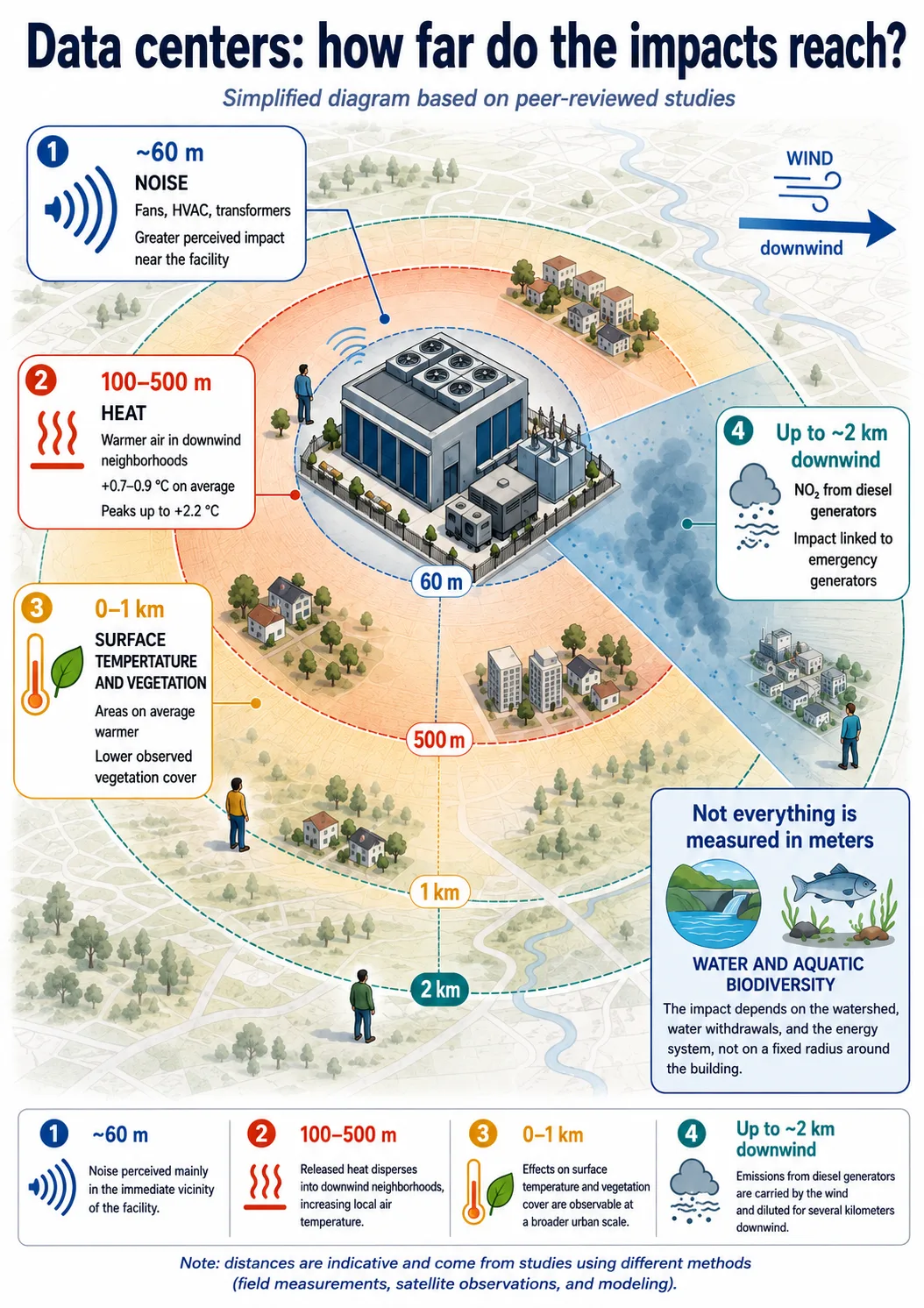
The available peer reviewed literature does not yet allow us to establish a general "safe distance", but it does let us identify some interesting scales. The most recent studies have detected thermal effects up to about 500 meters, acoustic differences at about 60 meters, land and vegetation anomalies within 1 kilometer and, in simulations of diesel generators, increases in pollutants up to about 2 kilometers downwind. These are results that deserve attention, but they must be read correctly.
The most directly measured problem: heat
A data center uses enormous amounts of electricity, and almost all of this energy, after being used by servers and equipment, must finally be dissipated as heat. For many years this phenomenon was understood from an engineering point of view, but something fundamental was missing, namely measuring whether that heat actually changed the air temperature in the surrounding neighborhoods.
In 2026 David J. Sailor, Soroush Samareh Abolhassani and Eli P. Martin of Arizona State University published one of the most interesting works available so far, Data Center Waste Heat as an Emerging Urban Thermal Hazard: First Field Measurements of Neighborhood-Scale Air Temperature Impacts. The researchers carried out mobile temperature measurements around four operational data centers in the Phoenix metropolitan area, in Arizona, and the facilities analyzed ranged from a 36 MW building to a 169 MW colocation campus.
The result is significant. In the neighborhoods located downwind of the facilities the air was on average between 0.7 and 0.9 °C warmer than the corresponding upwind areas, and in some transects the maximum difference observed reached 2.2 °C. Above all, the thermal signature of the data center was still detectable at distances roughly between 100 and 500 meters from the perimeter of the facility.
The measured effect therefore reaches up to about 500 meters. This does not mean that every data center automatically raises the temperature by two degrees within 500 meters, because the result depends on the power of the facility, on the cooling systems, on the wind, on the urban morphology, on the season and on the weather conditions. But it means something equally important, namely that the heat produced by large data centers does not necessarily stay confined within the property, and it can create a measurable thermal plume in the surrounding neighborhoods. In cities already affected by the urban heat island, this element becomes particularly relevant in land use planning.
Another trace emerges from satellites: warmer and less vegetated
A second work published in 2026 examined 46 buildings used as data centers in the Phoenix area, using ECOSTRESS and Landsat satellite imagery, and compared areas located at different distances from the facilities, that is within 1 km, between 1 and 2 km and between 2 and 3 km. Within the first kilometer the average surface temperature measured was about 39.74 °C, against 39.26 °C for the metropolitan area as a whole, a difference of about 0.48 °C. The satellite vegetation index NDVI was also lower, 0.15 within one kilometer of the data centers against 0.17 for Phoenix as a whole.
Beware of causality, though. This study does not prove that the data center directly made the vegetation disappear, because data centers tend to be built in industrial zones already characterized from the start by large buildings, parking lots, impermeable surfaces and less greenery. The authors themselves stress that the analysis is exploratory and does not allow a cause and effect relationship to be established. The result remains interesting from an urban planning point of view, because around the data centers analyzed there is a zone characterized at the same time by higher surface temperature and lower vegetation cover, particularly evident within about 1 km.
But heat can become a resource: the example almost nobody considers
So far we have talked about heat as a problem, a thermal plume leaving the perimeter. But there is a concrete example that completely flips the perspective, and that strangely rarely enters the public debate: if that heat, instead of being dumped, is recovered, a data center can become the heating system of a neighborhood.
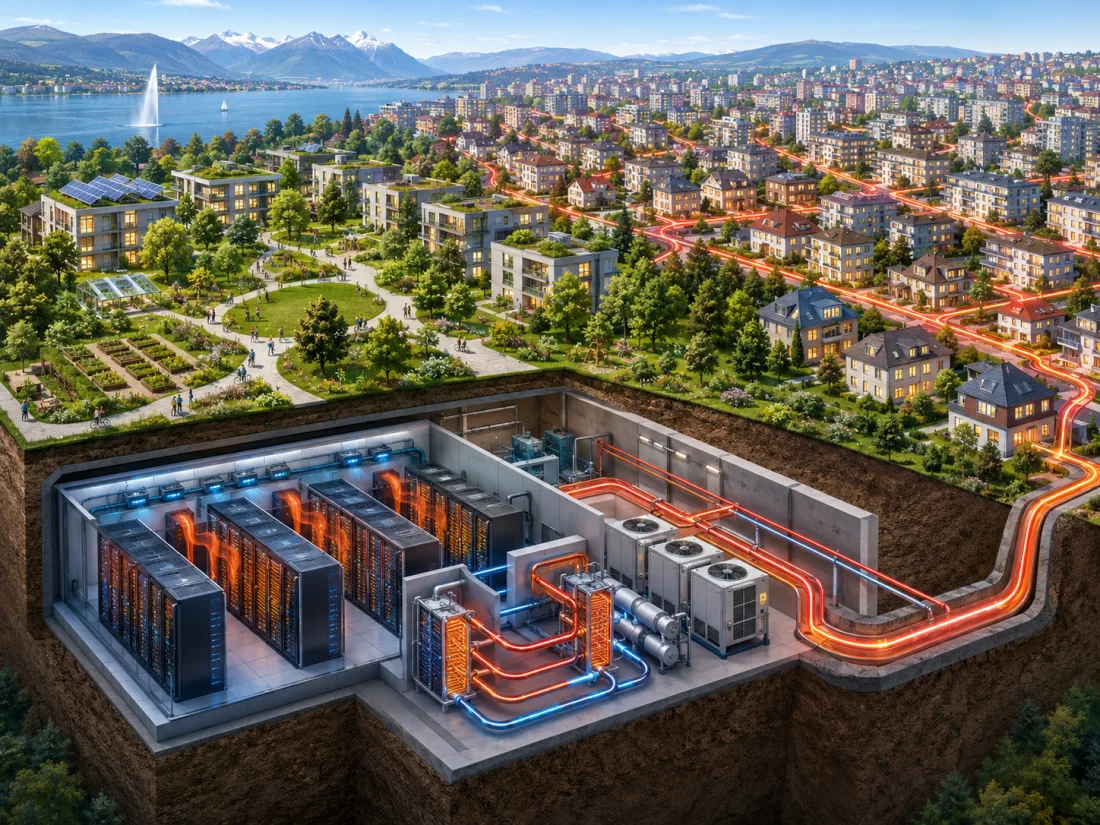
This is exactly what Infomaniak, a Swiss cloud provider, did with its D4 data center inaugurated in Geneva on 27 January 2025. The facility was built underground beneath the eco-district of the participative cooperative La Bistoquette, so with no impact on the landscape, and it recovers 100% of the electricity it consumes, turning it into heat fed into the district heating network of the canton of Geneva. The heat, produced by the servers at around 40 to 45 °C, is raised with heat pumps and distributed to the homes. The project was carried out together with the La Bistoquette cooperative itself and Services Industriels de Genève, the local utility, and it fits into a precise regulatory framework, the Geneva law on structuring thermal networks, in force since 1 January 2025, which pushes to replace fossil heating with renewable and recovered energy.
The figures help to grasp the scale. At full capacity the data center will feed about 14.9 GWh per year into the network, equal to 1.7 MW of recovered heat, the energy needed to warm about 6,000 low consumption Minergie-A homes during winter, or to provide the hot water for 20,000 five minute showers a day in summer. The facility runs about 10,000 servers and has been feeding heat into the network since 11 November 2024, though for now it operates at about a quarter of its potential, with full capacity expected by 2028. The recovery avoids thousands of tons of CO₂ every year compared with gas or wood pellets.
Here it is worth pausing to think. A community that today fears a data center near its homes because it associates it with dumped heat, noise and consumption, faced with a facility like this could do a different calculation: instead of a shed that warms the neighborhood air and gives nothing back, an underground infrastructure that in winter warms their homes, often at lower cost and without burning fossil fuels. It is reasonable to think that many people would more willingly accept a data center in exchange for winter heating, especially where cold weighs on the bills.
And there is a second aspect, of an energy nature. For about half the year, the cold season, the heat that the data center would dissipate anyway becomes heat that the homes no longer have to produce by burning gas or pellets. It does not mean that the data center consumes less electricity, that stays, but it means that a part of that energy, instead of being thrown away, replaces the neighborhood's heating demand. On the local energy balance, in the months when heating is on, the consumption added by the facility is offset at least in part by the consumption removed from the homes. In summer the benefit is smaller and limited to domestic hot water, but in the cold half of the year the recovery genuinely changes the equation.
Of course it is not a universal solution. It works when the data center is designed for recovery from the start, when a district heating network nearby exists or is built, when regulation encourages it and when there is a community willing to host it, such as a cooperative of residents. But it shows that the same heat that appears as a thermal hazard in the earlier studies can, with the right design, become the main reason why a neighborhood would want a data center next door, instead of fearing it.
Noise: differences measured as close as about 60 meters
Another problem frequently reported by communities living next to large data centers is continuous noise, whose sources are numerous, namely large fans, chillers, pumps, HVAC systems, transformers, servers and emergency generators. One of the few works that has directly compared neighborhoods located at different distances was presented in 2025 at the peer reviewed ACM COMPASS conference by researchers from MIT and the University of Massachusetts Amherst.
The study, The Cloud Next Door: Investigating the Environmental and Socioeconomic Strain of Datacenters on Local Communities, carried out preliminary measurements in Ashburn, Virginia, one of the areas with the highest concentration of data centers in the world. The researchers compared a residential area located about 200 feet from the facility, equivalent to about 61 meters, with a control neighborhood about 2 miles away, that is 3.2 kilometers, using the NIOSH sound level meter. The average sound level reported was about 28.0 dB at 61 meters, against about 22.3 dB at 3.2 km. The noise was therefore systematically higher near the data center, and the authors also describe the presence of a persistent low frequency hum. These are, however, preliminary measurements and a limited number of readings, so it would not be correct to turn these values into a universal rule.
The real problem with noise is what is still not measured well. A scientific review published in August 2026 highlighted a surprising gap: although fans, HVAC, transformers and generators can produce low frequency components, there are still no published studies that have systematically characterized the spectrum of infrasound and very low frequency noise of an operational data center and at the same time studied the health effects on the surrounding residents. This means that it is correct to state that the noise of data centers is real and measurable, while it is not scientifically correct to state, on the basis of the evidence available today, that the infrasound of data centers causes a specific illness in the people living nearby. That research still has to be done.
Air quality: the problem of diesel generators
A large data center cannot afford to shut down in the event of a grid outage, and for this reason the facilities generally have emergency generator sets, often diesel, which have to be periodically started for tests and maintenance and can come into operation during blackouts or emergencies. Here the literature provides interesting indications about distance, but with an important caveat, because one of the most cited studies is a model, not a direct measurement of pollutant concentration in the neighborhoods.
A study published in the Journal of the Air & Waste Management Association simulated a data center producing 10 MW of emergency power through diesel generators without abatement systems, running for two hours. The result showed modeled increases in NO₂ concentration between 10 and 50 ppbv within about 2 kilometers downwind, while for particulate matter the maximum simulated increases were between about 1 and 5 µg/m³ in the first few hundred meters from the facility.
In this scenario, therefore, particulate matter concentrates mainly in the first few hundred meters, while NO₂ shows a modeled signal up to about 2 km downwind. It is important to stress again that this is a simulation based on a specific generator operating scenario, and it does not amount to saying that at any moment people within two kilometers of a data center are exposed to that NO₂ increase. It does show, however, that the simultaneous use of large banks of diesel generators can produce an atmospheric impact that does not stop at the boundary of the facility. It is no coincidence that, in 2026, the Virginia Department of Environmental Quality launched a dedicated network of sensors in the "Data Center Alley" area to actually measure NO₂, PM2.5 and CO in the neighborhoods characterized by a high concentration of data centers: this is public monitoring still under way and not a peer reviewed paper, but it shows how concrete the issue has become for environmental authorities too.
Water: here distance can be a misleading measure
For water we have to change perspective completely. Some data centers use evaporative cooling systems that can require large amounts of water, and to this direct consumption we must add the water used indirectly to produce the electricity the facility consumes. One of the fundamental studies is the one by Siddik, Shehabi and Marston, published in 2021 in Environmental Research Letters: analyzing spatially the water footprint of US data centers, the authors found that about one fifth of the direct water footprint of the servers was in basins characterized by moderate or high water stress, while almost half of the servers depended at least in part on power plants located in water stressed regions. A review published in npj Clean Water also highlighted the difficulty of knowing real consumption because of the limited transparency of the sector, and reported that, in the data available at the time, a significant part of the water used could come from drinking water resources.
But how far does the effect reach? Here it makes little sense to talk about 500 meters, one kilometer or two kilometers, because if the water is drawn from an aquifer or a river basin the consequences depend on the geology, on the availability of the resource, on the season and on the other users of the same water system. A data center can therefore have a significant water impact even on ecosystems that are not immediately next to the building.
Biodiversity and wildlife: one of the big questions still open
In 2026 a work with an emblematic title was published in Water Biology and Security, Data centers: an emerging threat to freshwater biodiversity in the United States. The authors analyze several pathways through which the growth of data centers can affect freshwater ecosystems, namely water withdrawals for cooling, water demand linked to thermoelectric generation, changes in the use of hydroelectric plants, flow alterations and the risk of entrainment of aquatic organisms.
The work is important, but its meaning has to be understood well. It does not prove that at 300 meters or at 1 km from a data center the number of fish, amphibians, insects or birds automatically decreases, but it builds a scientific framework of the possible mechanisms through which the enormous water and electricity demand of digital infrastructure can propagate into ecosystems. And it is precisely here that one of the biggest gaps in current research emerges, because there are still no longitudinal ecological studies of the type biodiversity census before the data center is built, monitoring during construction, monitoring after it starts operating and comparison with control areas. For terrestrial biodiversity we know a lot about the general mechanisms associated with land consumption, soil sealing, habitat fragmentation, noise, lighting and microclimate alteration, but we still have relatively few specific measurements taken around data centers.
So what do the distances tell us?
Putting the available studies together, a first interesting picture emerges, because the impacts do not all have the same geography. Noise can become relevant in the immediate vicinity of the facility, heat can produce a measurable plume for a few hundred meters, surface temperature and vegetation characteristics show differences observable on a scale of the order of a kilometer even if it is not yet possible to attribute them entirely to the data center, while the emissions of diesel generators, when they run, can be carried by the wind for greater distances, with models showing NO₂ variations up to about 2 km downwind. The impacts on water and on aquatic ecosystems can have a scale that is different again, determined not by linear distance but by the river basin and the energy system.
In short, heat in the air has been measured directly in the field up to about 500 meters, community noise shows, with preliminary direct measurements, a difference as close as about 61 meters compared with the 3.2 km of the control neighborhood, surface temperature and vegetation from correlative satellite observations stand out mainly within 1 km, particulate matter from diesel generators concentrates according to atmospheric modeling mainly in the first few hundred meters, NO₂ again from modeling reaches up to about 2 km downwind, while water and aquatic biodiversity do not follow a fixed radius but the scale of the river basin.
These numbers should not be read as a proposal for "safety bands". To define the compatibility of a project with a territory you would need to know at least the electrical and thermal power of the facility, the cooling technology, the number and power of the generators, the authorized emissions, the terrain, the prevailing winds, the surrounding land uses, the water availability and the ecological sensitivity of the area.
The central point: a data center is not a neutral building
The main conclusion that emerges from the scientific literature is perhaps this: a data center should not be evaluated only as a large industrial shed, because it is at the same time a large heat source, a continuous consumer of energy, a possible large user of water, an infrastructure equipped with significant cooling machinery and a structure that generally has emergency generators. The first field measurements also show that at least some of these effects can physically cross the boundary of the property.
This becomes particularly important when new facilities are located near residential neighborhoods, schools, hospitals, farmland, watercourses or natural habitats. Science does not yet let us establish a universal distance beyond which a data center automatically becomes harmless, but it lets us state something different and probably more important, namely that considering only what happens inside the fence of the data center is no longer enough. A modern environmental assessment should analyze at least the microclimate within a few hundred meters, the noise at the residential receptors, the dispersion of generator emissions on a kilometer scale, the water balance at basin scale and the cumulative effects when several data centers are concentrated in the same territory.
Because the "cloud" may seem immaterial, but the infrastructure that makes it possible occupies a very real piece of land.
Key scientific references
- Sailor D.J., Samareh Abolhassani S., Martin E.P. (2026), Data Center Waste Heat as an Emerging Urban Thermal Hazard: First Field Measurements of Neighborhood-Scale Air Temperature Impacts, Journal of Engineering for Sustainable Buildings and Cities. DOI: 10.1115/1.4071922.
- Molla A. (2026), In my backyard? Digital heat islands and the environmental justice of AI infrastructure in Phoenix, Climate Physics and Atmospheric Science. DOI: 10.1016/j.cpas.2026.100016.
- Ngata W.M. et al. (2025), The Cloud Next Door: Investigating the Environmental and Socioeconomic Strain of Datacenters on Local Communities, Proceedings of ACM COMPASS '25. DOI: 10.1145/3715335.3736324.
- Microscale air quality impacts of distributed power generation facilities (2016), Journal of the Air & Waste Management Association. DOI: 10.1080/10962247.2016.1184194.
- Siddik M.A.B., Shehabi A., Marston L. (2021), The environmental footprint of data centers in the United States, Environmental Research Letters, 16, 064017. DOI: 10.1088/1748-9326/abfba1.
- Mytton D. (2021), Data centre water consumption, npj Clean Water, 4, 11. DOI: 10.1038/s41545-021-00101-w.
- Jager H. et al. (2026), Data centers: an emerging threat to freshwater biodiversity in the United States, Water Biology and Security. DOI: 10.1016/j.watbs.2026.100585.
- Wheeler M.R. et al. (2026), Infrasound and Low-Frequency Noise in Data Center Environments: A Narrative Review Toward Health-Protective Acoustic Design Standards, Clean Technologies, 8(4), 126. DOI: 10.3390/cleantechnol8040126.
- Infomaniak (2025), Infomaniak inaugurates a data center that recovers 100% of its energy for building heating (official announcement). news.infomaniak.com
- Euronews (2025), Geneva's homes will be heated by recycled energy from this revolutionary Swiss data centre. euronews.com