A data center in space: what SpaceXAI wants to do with NVIDIA, and how it would actually work
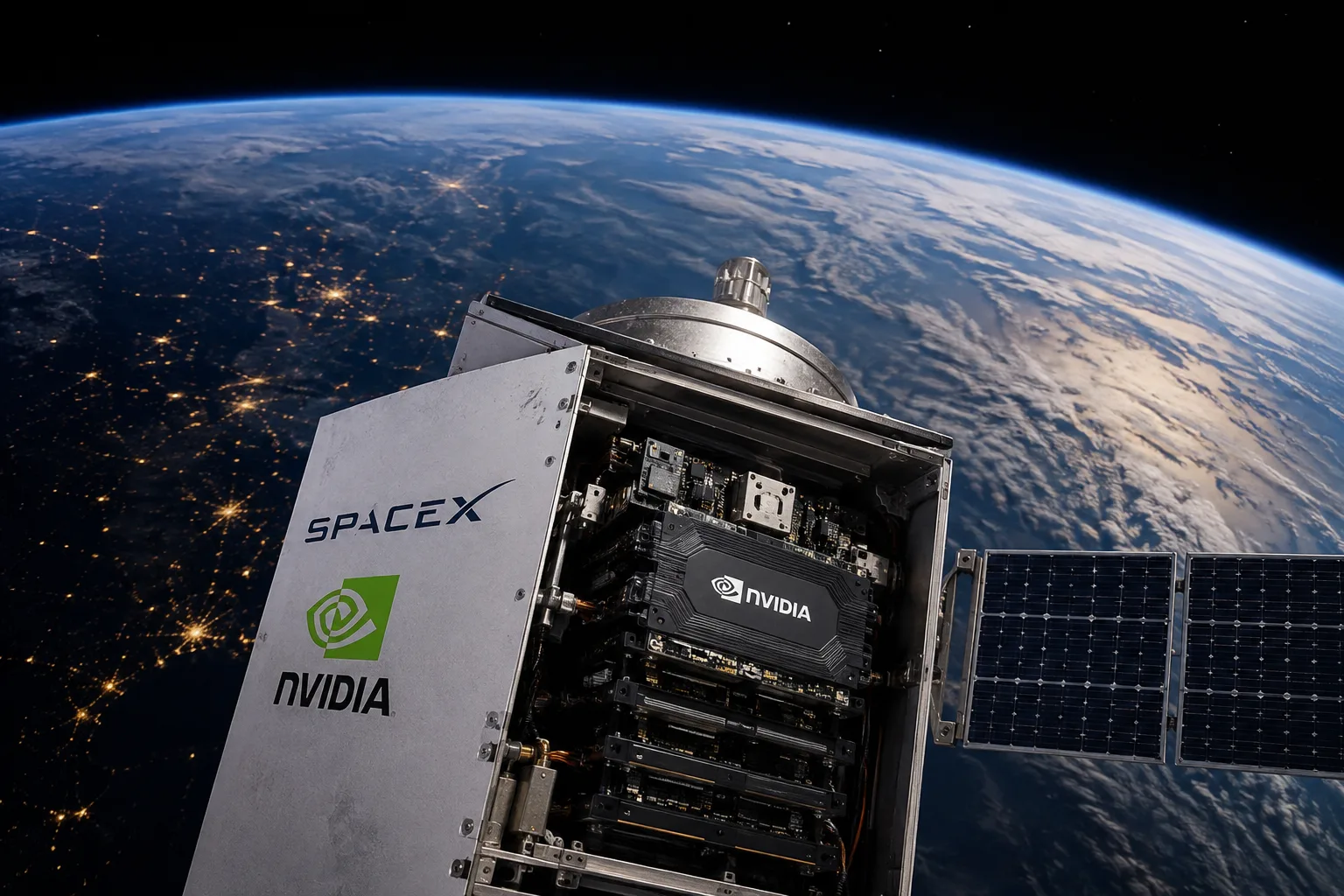
At first glance the idea seems lifted straight from a science fiction novel: take part of the enormous computing power concentrated today in ground based data centers, put it on satellites powered by the Sun, and use those orbiting computers to run artificial intelligence systems.
This is exactly the direction of SpaceXAI's Starmind project. And the plan has now become more concrete thanks to a collaboration with NVIDIA: SpaceXAI has announced the large scale adoption of the new NVIDIA Vera CPUs, while the two companies are working on a space optimized version of the Vera Rubin NVL72 platform, with the stated goal of bringing it into orbit aboard a first generation of Starmind satellites. NVIDIA explicitly talks about an infrastructure that, starting from the large terrestrial data centers, should reach all the way to orbital computing.
But to understand why anyone would want to build a "data center in space", you first have to understand which problem they are trying to solve.
The problem: artificial intelligence is becoming a question of energy
When we use a chatbot, all we see is a box where we type a question. Behind that box, however, there can be thousands of processors working at the same time.
Large artificial intelligence models must first be trained, an operation that requires enormous amounts of computation, and then they have to be run every time a user makes a request. This second phase is called inference.
With the arrival of so called agentic AI, the problem becomes even more complex.
A normal chatbot can receive a question, process it, and return an answer. An AI agent, on the other hand, may have to:
- interpret the task;
- query databases;
- carry out searches;
- run programs;
- call other models;
- analyze the results;
- correct its own mistakes;
- repeat the process several times before producing an answer.
In other words, it does not perform a single operation: it coordinates a chain of operations.
And this is where NVIDIA Vera comes into play.
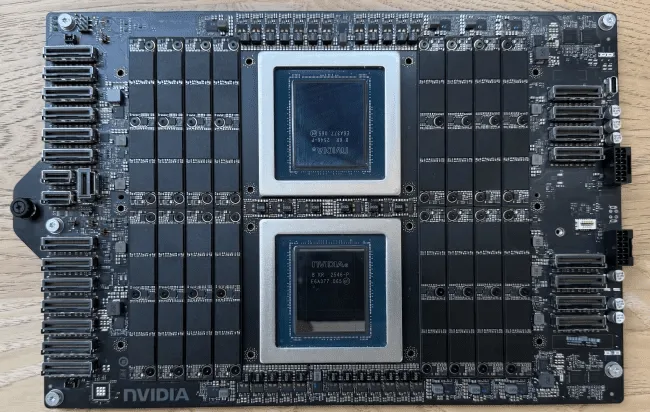
Vera is not a GPU: it is the "conductor" of the AI
When people talk about artificial intelligence, NVIDIA is associated above all with GPUs. These are processors that are extremely efficient at performing very many mathematical operations in parallel, and they form the heart of modern AI systems.
But a GPU does not work alone.
Someone has to prepare the data, manage the operating system, run Python code, coordinate the various programs, distribute the tasks, move information between memory and accelerators, and decide which GPU should carry out a given operation.
This job falls mainly to the CPU.
With AI agents the CPU's workload grows considerably. This is why NVIDIA designed Vera specifically for this kind of infrastructure.
The Vera CPU features 88 Olympus cores designed by NVIDIA and LPDDR5X memory capable of reaching up to 1.2 terabytes per second of bandwidth. NVIDIA claims that, on certain types of workload, it can complete operations up to 1.8 times faster than the x86 CPUs normally used in servers.
A metaphor helps to understand its role.
We can imagine the GPU as a giant team of thousands of extremely fast workers. Vera is the foreman who has to make sure they all constantly have something to do.
A very powerful GPU that has to wait for data or instructions is wasted money and wasted energy.
The goal of the new architecture is precisely to avoid this bottleneck.
Vera Rubin: not a single computer, but an "AI factory"
Vera is only one of the components.
NVIDIA pairs the Vera CPU with GPUs from the Rubin generation, creating the platform called Vera Rubin.
The terrestrial Vera Rubin NVL72 configuration is a system designed at the level of an entire rack: in the standard version it connects 72 Rubin GPUs and 36 Vera CPUs, together with dedicated systems for networking, storage, and data management. The GPUs are linked through NVLink technology, which lets them exchange enormous amounts of information at latencies far lower than those of a normal Ethernet network.
This point is important because modern AI models are often too large to fit into the memory of a single accelerator.
The model is therefore split across many GPUs.
During processing, these GPUs have to talk to each other continuously.
The speed of the single chip matters, then, but what matters just as much is the speed at which hundreds of chips manage to behave as if they were a single enormous computer.
This is the idea behind the term NVIDIA uses more and more often: AI factory.
The input consists of data and electrical energy; the output, put simply, are the tokens produced by the AI models.
And SpaceXAI wants to take this factory and put it in space
Here begins the most unusual part of the project.
SpaceXAI and NVIDIA do not simply intend to take a terrestrial NVL72 rack, load it onto a rocket, and switch it on in orbit. NVIDIA talks about a system based on the Vera Rubin NVL72 architecture but optimized specifically for space.
The distinction is fundamental.
A terrestrial data center rack is designed on the assumption that there is a building around it: electrical power, pumps, piping, cooling systems, networking, maintenance, and staff.
A satellite has none of this.
The computer has to become an integral part of the spacecraft.
The Starmind project describes a satellite called AI1, with a structure that, once deployed, would reach about 20 meters in height and 70 meters in span, mainly because of the large surfaces needed to produce energy and to manage the system thermally. For this configuration SpaceX indicates a computing load of up to 150 kW peak and about 120 kW on average.
So we are not talking about a small computer mounted on a normal satellite.
We are talking about the satellite itself designed as an orbital computer powered by the Sun.
How would it work, concretely?
In a very simplified form, the system could be imagined like this:
Earth → Starlink → laser link → Starmind satellite → AI processing → laser link → Starlink → Earth
The user would continue to use an apparently normal service.
A request could leave a computer or a smartphone, reach the terrestrial network infrastructure, and then be forwarded toward the constellation.
Once it arrives at the satellite, the data would be processed locally.
The Vera CPUs could handle the orchestration part: managing the agent, running code, preparing the data, running simulations, and coordinating the operations.
The Rubin GPUs would instead carry out the massively parallel part of the AI inference.
The result, much smaller than the intermediate data generated during the computation, could then be sent back toward Earth.
SpaceX states that the Starmind satellites will use high speed laser links and that they will be able to exploit the Starlink network to forward the data. The application that SpaceX submitted to the Federal Communications Commission also explicitly foresees optical links between satellites and the possibility of interconnecting the future orbital data center network with the Starlink constellations.
This is a decisive detail.
A constellation of space computers without a very fast network would be of little use. To make thousands of distributed nodes work together you have to transfer data continuously, and in space lasers can be the equivalent of the fiber optic backbones used in terrestrial data centers.
Why go to space instead of building more data centers?
The main reason is not that "computers work better in space".
The reason is energy.
A giant terrestrial AI data center requires hundreds of megawatts and, in the most ambitious projects, people now talk about infrastructures on the order of gigawatts.
This means finding power plants, high voltage lines, transformers, land, permits, water, or alternative cooling systems.
SpaceXAI starts from a different consideration: in orbit, solar energy is available without atmosphere, clouds, or weather cycles, and it can be collected directly by large photovoltaic panels.
In theory, by increasing the number of satellites you can also increase the computing power without having to build new power plants and new terrestrial electrical grids at the same time.
But this does not mean that energy is "free".
You have to build the panels, carry them into space, orient them, and size batteries or other forms of storage for the phases in which the satellite does not receive the expected sunlight.
This is why SpaceX considers Starship a fundamental component of the project: the economics of the system depend on the ability to lift enormous quantities of solar panels, electronics, radiators, and structures into orbit at a low enough cost.
The real technical problem of space: how to get rid of the heat
Then there is an aspect that is often counterintuitive.
Space is extremely cold, but cooling a computer in space is not necessarily simple.
On Earth we can get rid of heat by pushing air through a server or by transferring it to a water circuit.
In the vacuum there is no air.
So there is neither convection nor the possibility of simply putting a fan in front of a GPU.
The heat has to be transferred from the chips to an external surface and then expelled through infrared radiation.
The physics is described, to a first approximation, by the Stefan Boltzmann law:
P = εσAT⁴
where the amount of energy radiated depends on the radiator surface A and, above all, on the fourth power of its temperature T.
Translated: if you want to dissipate hundreds of kilowatts produced by extremely dense electronics, you need considerable radiating surfaces.
SpaceX argues that, by eliminating the chillers, cooling towers, and fans typical of terrestrial data centers, Starmind could sharply reduce the energy consumed purely for cooling.
But the heat does not disappear.
It still has to be carried from the processors to the radiators and radiated into space.
And this is one of the central engineering problems of the project.
Then there is radiation, and for modern chips it is a serious problem
Another difference compared to a terrestrial data center is the radiation environment.
Modern processors use microscopic transistors and work at very low voltages. An energetic particle can produce a single event upset, that is, temporarily flip a bit, or cause more serious problems.
Traditional satellites often use "radiation hardened" components, designed specifically to tolerate radiation.
The problem is that the most advanced AI chips are built using very different manufacturing processes and with development cycles enormously faster than traditional space electronics.
If you want to bring a platform similar to Vera Rubin into orbit, you therefore have to find a compromise between performance, shielding weight, redundancy, error tolerance, and operational lifetime.
One possible philosophy consists of not trying to make every computer indestructible.
If the satellites are produced in large quantities and can be replaced periodically, it can become economically sensible to design a redundant and replaceable infrastructure, more similar to a giant distributed cloud than to a space probe built to survive twenty years without maintenance.
And this is probably where SpaceX's experience with Starlink becomes particularly important.
A million satellites? Be careful about what that number means
The most spectacular figure associated with the project is a million satellites.
It should, however, be interpreted correctly.
In January 2026 SpaceX submitted to the FCC a request to build a new non geostationary system called the SpaceX Orbital Data Center System, potentially made up of up to a million satellites, distributed at altitudes between roughly 500 and 2,000 kilometers. The documentation foresees laser links between satellites and links with Starlink.
"Up to a million" does not, however, mean that SpaceX has already ordered, financed, or scheduled the launch of a million satellites.
It is the maximum size of the constellation for which the regulatory procedure has been started.
Moreover, a request to the FCC is not the same as a final authorization.
It is therefore important to separate three levels of the project:
- the concrete technology, such as Vera, Rubin, Starlink, the laser links, and the launch systems;
- the first Starmind generation, on which SpaceXAI and NVIDIA are actually working;
- the giant scale vision, which imagines a real network of orbital data centers made up of enormous quantities of satellites in the future.
Confusing these three levels makes something that is still only a plan today look as if it already exists.
The first test bench will arrive in 2027
According to NVIDIA, the first Starmind satellite should use an optimized variant of the Vera Rubin NVL72 platform. Elon Musk has indicated the fourth quarter of 2027 as the target, then talking about a significant increase in scale in 2028.
SpaceX, on the site dedicated to Starmind, also states that it wants to use a new factory in Bastrop, Texas, to make possible the production and deployment of thousands of AI satellites starting, potentially, from the end of 2027.
These are, however, forecast dates, not achieved results.
Before an orbital data center can become economically competitive, many elements will have to be demonstrated at the same time: reliability of the electronics, thermal management, energy production, the laser network, satellite lifetime, launch cost, and the ability to replace the hardware quickly.
And would AI in space really be faster?
Not necessarily.
If the terrestrial data center is a hundred kilometers from the user, sending the request into space does not magically reduce the latency.
A satellite in low Earth orbit is in any case hundreds of kilometers from the surface, and the signal has to travel up and back down, possibly passing through several satellites.
The advantage should be sought above all elsewhere: availability of energy, the ability to expand capacity, and integration with a global satellite network.
In some very long distance communications, moreover, satellite laser links can be attractive because light in the vacuum travels faster than inside fiber optics and the path can be more direct.
But this does not mean that every AI request will automatically be faster if processed in space.
Finally, there is an important distinction: inference and training
When we imagine an "AI data center in space", we might think that the entire training of future models will take place in orbit.
That is not necessarily the case, at least at first.
Inference is particularly interesting for a distributed infrastructure because you can send a task to a node, run it, and retrieve the result.
Training a giant model, on the contrary, requires thousands or tens of thousands of accelerators to synchronize continuously, exchanging enormous amounts of data.
Making this kind of cluster work across a satellite constellation is much harder.
For this reason, at least in the early phases, it is reasonable to imagine a combination of infrastructures: large terrestrial AI factories for certain workloads and orbital capacity for others. NVIDIA itself presents Vera Rubin as a common platform that SpaceXAI wants to use both in its own terrestrial data centers and, in an adapted form, in space.
The real project, then, is not "putting Grok on a satellite"
Reducing Starmind to a satellite that runs Grok would be misleading.
The far more ambitious goal is to build a new layer of the world's computing infrastructure.
SpaceX owns the rockets to lift large masses into orbit and the Starlink network to connect them. SpaceXAI develops models and services that consume large amounts of computing capacity. NVIDIA supplies the hardware architecture needed to turn electrical energy into AI processing.
Starmind tries to unite these elements in a single chain:
Sun → electrical energy → CPUs and GPUs → artificial intelligence → laser links → users on Earth.
This is the truly interesting part of the project.
It is not simply about building a more powerful computer.
It is about checking whether it is possible to turn Earth orbit into a place where computing capacity is produced on an industrial scale.
If it worked, a future data center might no longer necessarily be a huge building surrounded by transformers, power plants, and cooling systems.
It could be a constellation of solar machines, connected to each other by lasers and continuously replaced with generations of more efficient processors.
But between this vision and a real orbital infrastructure on a gigawatt scale, enormous technical, economic, and regulatory problems remain.
And this is exactly what makes Starmind interesting: not because the data center in space is already a reality, but because for the first time technologies mature enough are converging, namely reusable rockets, satellite laser networks, and high efficiency AI hardware, enough to seriously test whether the idea can work.
Sources
- SpaceXAI Adopts NVIDIA Vera CPU to Accelerate Agentic AI at Massive Scale (press release, August 24, 2026)
- SpaceXAI Adopts NVIDIA Vera CPUs for Grok, With a Vera Rubin NVL72 Bound for Orbit in Starmind (StorageReview)
- Nvidia to build Starmind AI1 satellite compute payload for SpaceX (Interesting Engineering)
- Inside NVIDIA Vera CPU: Olympus Cores for Agentic AI (NVIDIA Technical Blog)
- NVIDIA Vera Rubin platform in depth (Tom's Hardware)
- Space Computing: On-Orbit AI and Accelerated Computing (NVIDIA)