5 GHz radio links over water: Fresnel, reflections and multipath
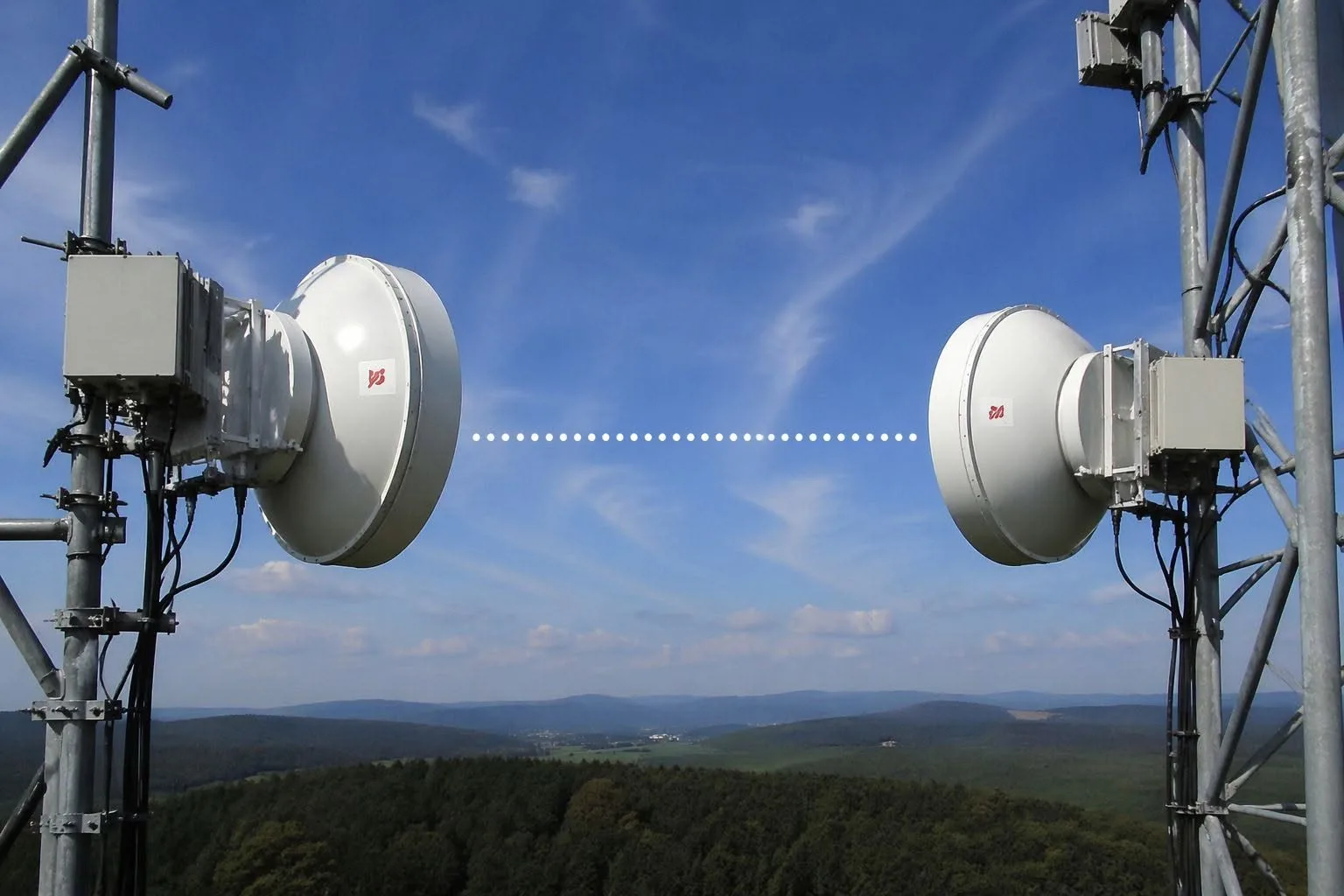
When designing a 5 GHz radio link, the first check is almost always optical visibility: "can the two antennas see each other?". If they can, many people consider the link a done deal, but that is not always enough.
For a stable link you also need a sufficiently clear Fresnel zone, a good signal margin and attention to reflections, especially when the path passes over water. A link over a lake, a wide river or the sea can work perfectly or show instabilities that are hard to explain: apparently good RSSI but shaky throughput, modulation that drops, low CCQ, retries, sudden dips.
The reason is usually not that the water "blocks" the signal like a wall. The typical problem is that the water behaves like a radio mirror, generating reflections and therefore multipath.
The Fresnel zone and the 60% rule
A radio wave is not a laser beam: it does not travel only along the direct line between the antennas, but occupies an ellipsoidal volume around it, the Fresnel zone. The most important is the first one, wide at the midpoint of the path and narrow near the antennas. This is why an obstacle halfway along the path matters more than one near an antenna.
The practical rule is to keep at least 60% of the first Fresnel zone clear: below that threshold the link can still work, but it becomes more likely to suffer extra attenuation, lower modulation, unstable throughput, more retries and less margin against fading and unusual weather conditions.
How to calculate it, with an example
The radius of the first Fresnel zone, with distances in km and frequency in GHz, is approximated by:
r = 17.32 · √( d₁ · d₂ / ( f · D ) )where d₁ and d₂ are the distances from the point to the two antennas, D is the total distance and f is the frequency. At 5 GHz the wavelength is about 6 cm (λ = c / f).
Example, a 2 km link, at the center (d₁ = d₂ = 1 km):
r = 17.32 · √(1 · 1 / (5 · 2)) = 17.32 · 0.316 ≈ 5.5 m
60%  →  5.5 · 0.6 ≈ 3.3 m
At the midpoint you therefore need about 3.3 m of clearance around the direct line. If the radio beam grazes the surface of the water, the link becomes delicate.
The water does not block: it reflects
If the surface is below the direct line, the water does not "block" the signal. The point is subtler: it reflects part of it. The receiver thus gets two copies of the same signal, the direct one and the one reflected off the water, which travel slightly different paths and arrive with different phase and delay.
If the two copies arrive in phase they add up; if they arrive in antiphase they partially cancel out. This is multipath: propagation over multiple paths, of which reflection is a primary cause. Put precisely: the water does not modify the direct signal as it passes, but it creates an out of phase reflected copy of it; it is the sum of the two at the receiver that produces the fading.
Why multipath causes problems
Multipath is not always a disaster: Wi-Fi 802.11n/ac/ax tolerates it and, indoors, it is the norm. But a point to point link between directional antennas should have a clean dominant path. When a strong reflection arrives off the water, the signal becomes variable over time, RSSI that oscillates, worse SNR, low CCQ, rising retries, MCS that goes up and down, inconsistent throughput, jitter, brief disconnections.
The deceptive aspect is that the signal can look strong. But what counts is quality, not just quantity, a strong signal full of reflections is worse than a slightly weaker but clean one.
Why water is a special case
A calm water surface is highly reflective for radio frequencies, and at 5 GHz (λ ≈ 6 cm) geometric variations of just a few centimeters are enough to change the relative phase between the direct and reflected paths. The simplified "two ray" model (received signal = direct + reflected) explains it well: with a path difference of about half a wavelength (λ/2 ≈ 3 cm) the reflection arrives almost in phase opposition.
This is why the link can change behavior for apparently minimal reasons: waves, wind, lake level, tides, boats, humidity, thermal stratification of the air, the swing between day and night. Over the sea you also get phenomena such as ducting.
A clear Fresnel does not mean no multipath
Careful: the 60% Fresnel concerns the obstacles on the main propagation, not the reflection. Multipath from water can appear even with the direct path perfectly clear. On a link over water you therefore have to check two things, the direct line with its Fresnel zone and the geometry of the reflection.
How to mitigate
Often you do not need to change technology, good installation choices are enough:
- Raise the antennas: it improves clearance and changes the geometry of the reflection (it has to be calculated, because raising them too much just shifts the reflection point).
- More directive antennas, with a narrow vertical lobe: they radiate less toward the water and "see" the reflection less.
- Tune the vertical tilt: do not illuminate the surface, maximize the direct path and minimize the reflected one.
- Increase the fade margin: designing with a thin margin over water is risky.
- Try the polarization: vertical and horizontal behave differently with respect to the reflection.
- Do not overdo the power: more power means more direct signal but also more reflected signal, and it can make things worse.
- Look at the right parameters: not just RSSI, but SNR, CCQ, retries, MCS, real throughput, jitter, difference between radio chains, behavior at different hours. Good RSSI and low CCQ is the classic sign of a "dirty" signal.
Before installing
It is worth preparing a small analysis: total distance, frequency, antenna height, elevation profile, minimum height above the water, radius of the first Fresnel at the center, available clearance, likely reflection point, type of antennas and vertical lobe width, expected signal margin. After installation, monitor for several days and not just a few minutes: a link over water can be excellent during the test and get worse at dawn, in the evening, with wind, calm water or haze.
In summary
Water is not automatically a problem, many links over lakes, rivers and sea work well. But it has to be taken seriously at the design stage. The risk is not only the Fresnel near the surface, it is the reflection that creates a second signal path capable of adding to or canceling out the direct one. This is why a link over water can give a present signal but unstable quality.
The practical rule: optical visibility, a clear Fresnel and good RSSI are not enough over water, you also have to reason about reflections, multipath and fade margin. A well designed link does not just try to "get there", it tries to get there with margin, cleanliness and stability.