When hardware had character, from the Psion Series 5 to the Gemini PDA
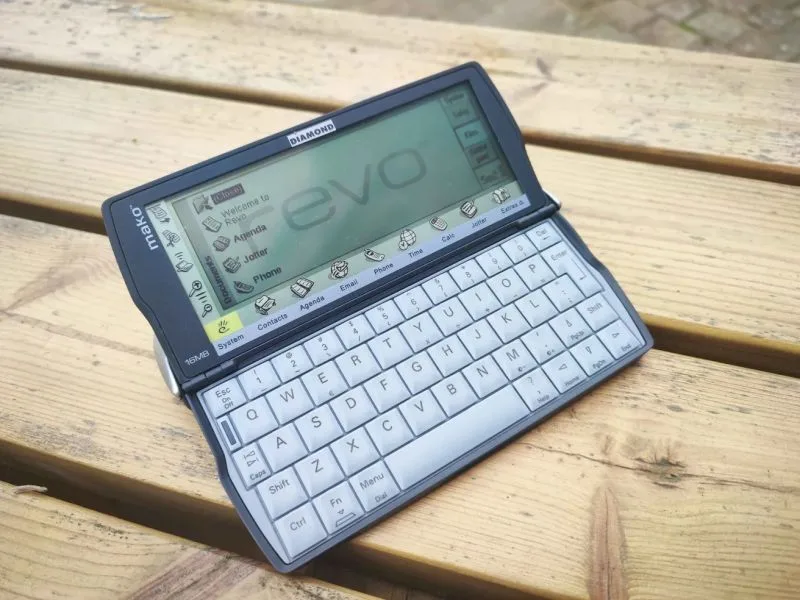
There are technological objects that grow old, and technological objects that simply belong to a different idea of the future.
For me the Psion Series 5 belongs to the second category.
It was one of the objects I longed for as a kid. I looked at it the way you look at something you do not fully understand but that seems to come from the future: a real computer, with a real keyboard, small enough to almost fit in your pocket. Above all it had an opening mechanism that even today, almost thirty years later, still manages to feel like a small mechanical magic trick.
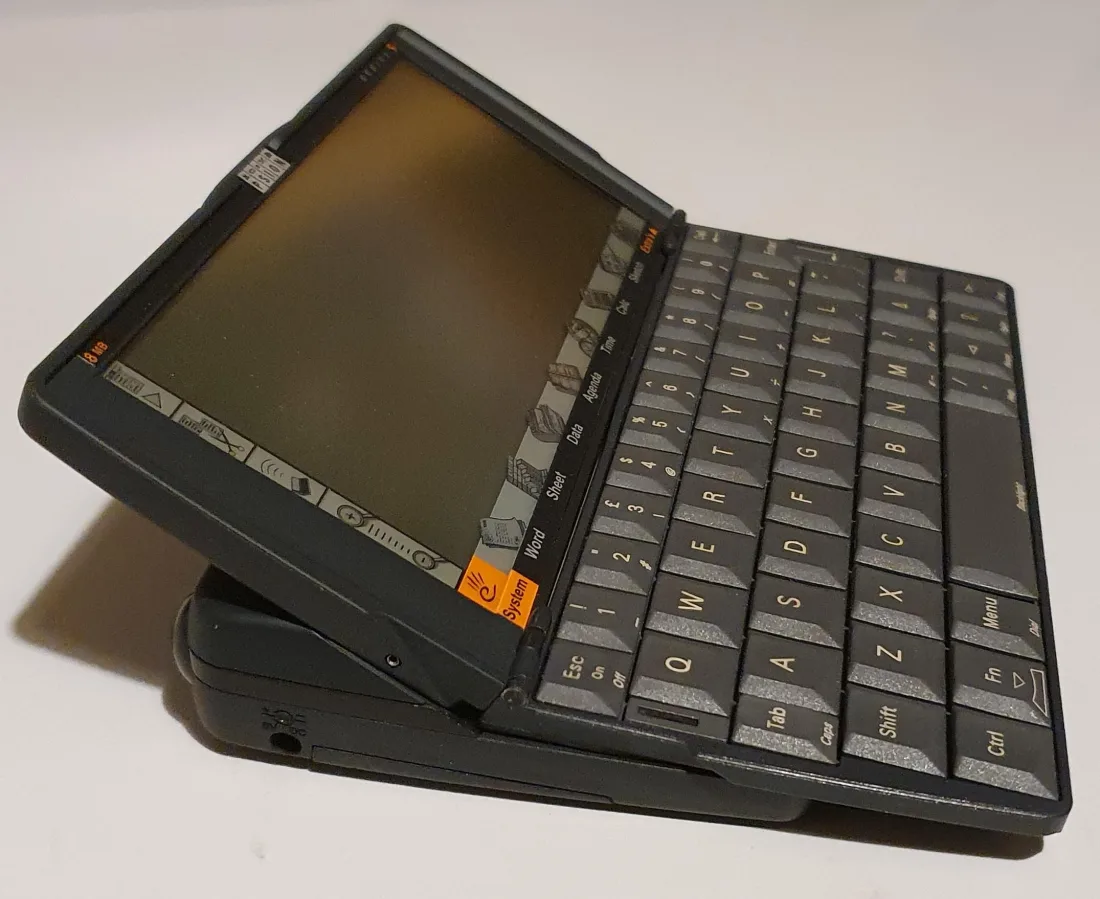
The Series 5 arrived in 1997. It measured about 170 by 90 by 23 millimeters, weighed 354 grams with the batteries, and had a keyboard designed for surprisingly serious typing despite its size. But the interesting point was not the specifications. It was the way the object transformed when you opened it.
The keyboard slid forward, the screen took its position, and the whole device changed its geometry to become a stable machine on the table. It was not a hinge placed there to connect two halves. It was part of the interface.
Behind that solution was Martin Riddiford, an industrial designer at Therefore Design. Riddiford worked on the Psion keyboards and on the mechanisms of the Series 3, Series 5, and Revo. In the Series 5 the movement of the keyboard also served to shift the support and to keep the device from tipping over backward while you used the touchscreen.
This, to me, is industrial design.
Not putting a more precious material around the same rectangle. Not shaving half a millimeter off a bezel. Not moving the cameras to make next year's model recognizable.
Designing the physical behavior of a machine.
When a PDA was truly personal
The era of PDAs had a characteristic we have almost forgotten today: the objects were different because they tried to solve different problems.
A Palm did not think like a Psion. A Psion did not think like a Pocket PC. The dimensions, the stylus, the keys, the shortcuts, the orientation of the screen, the operating system, were all consequences of a precise idea of use.
The Psion Series 5 came with a word processor, a spreadsheet, a database, a calendar, and the ability to program directly on the device. It did not feel like a terminal through which to consume services. It felt like a small computer of your own.
It was not perfect, of course. Hinges, moving parts, and above all some problems with the screen's flat cable became famous as the Series 5 and 5mx aged. But this is exactly what makes the design even more remarkable: after almost thirty years we still talk about its keyboard, its opening, its mechanical balance. It is hard to say the same about many devices released three years ago.
Then that category practically vanished.
Psion left the consumer market for handhelds in 2001, while part of the EPOC software legacy had already flowed into Symbian, born with the involvement of Nokia, Ericsson, Motorola, and Psion itself. And the PDA was progressively absorbed by the phone.
From a commercial standpoint it was inevitable. From a design standpoint, in my opinion, we lost something.
The smartphone won. Maybe even too much.
It would make no sense to deny what smartphones have given us.
An iPhone or a good modern Android is an object of extraordinary convenience. Communication, navigation, authentication, payments, photography, music, mail, documents, maps, almost instant access to any service. The touchscreen eliminated dozens of physical controls and made it possible to reconfigure the interface according to the application. In terms of usability it was a real revolution.
The problem is that this solution worked so well that it eliminated almost all the alternatives.
Today we take a rectangle of glass, we make it more or less large, we add a few cameras, and we move all the personality of the device into the software.
The hardware no longer describes what you will do with the machine.
The phone of a systems administrator, that of a photographer, that of a writer, and that of someone who spends the day on social media are the exact same object. And even when we talk about customization, almost always we are talking about software: launchers, wallpapers, widgets, applications. The physical machine stays unchanged.
For me it is a form of flat technology. Refined, convenient, powerful, but flat.
The operating systems too have followed that path: the expected experience is to enter an ecosystem and install approved applications to do certain things. The idea of considering the device simply as a computer, on which to freely build your own environment, has become much less central.
My problem is very concrete
I find myself practically 365 days a year carrying two devices around: an iPhone and a ThinkPad. Not just on workdays. Also on holidays, weekends, and vacations.
The reason is simple. The iPhone keeps me reachable and handles the whole everyday part of digital life very well. But when I have to actually do something, I go back to the ThinkPad.
My environment is Linux. Browser, terminal, SSH, VPN, files, web consoles, USB-C Ethernet adapters, a mouse when needed, a monitor when I am in the office.
And so the question I keep asking myself is this: in 2026, would it really be possible to go back to using a PDA?
Not as a nostalgic exercise. As a work tool. So as not to carry around a computer weighing over a kilo just because I might need to open a terminal for five minutes.
My ideal PDA should do few things, but do them for real:
- be small enough to always have it with me;
- also be a phone;
- actually run Debian, with a working 4G modem and, ideally, allow phone calls directly from Linux;
- once at the office, become a workstation by connecting a monitor, mouse, keyboard, and Ethernet, ideally through a single USB-C cable.
I am not looking for a phone with a little keyboard. I am looking for a pocket Linux computer that, incidentally, also knows how to be a phone.
And this is where Martin Riddiford reappears.
Gemini PDA: the Psion that arrives twenty years later
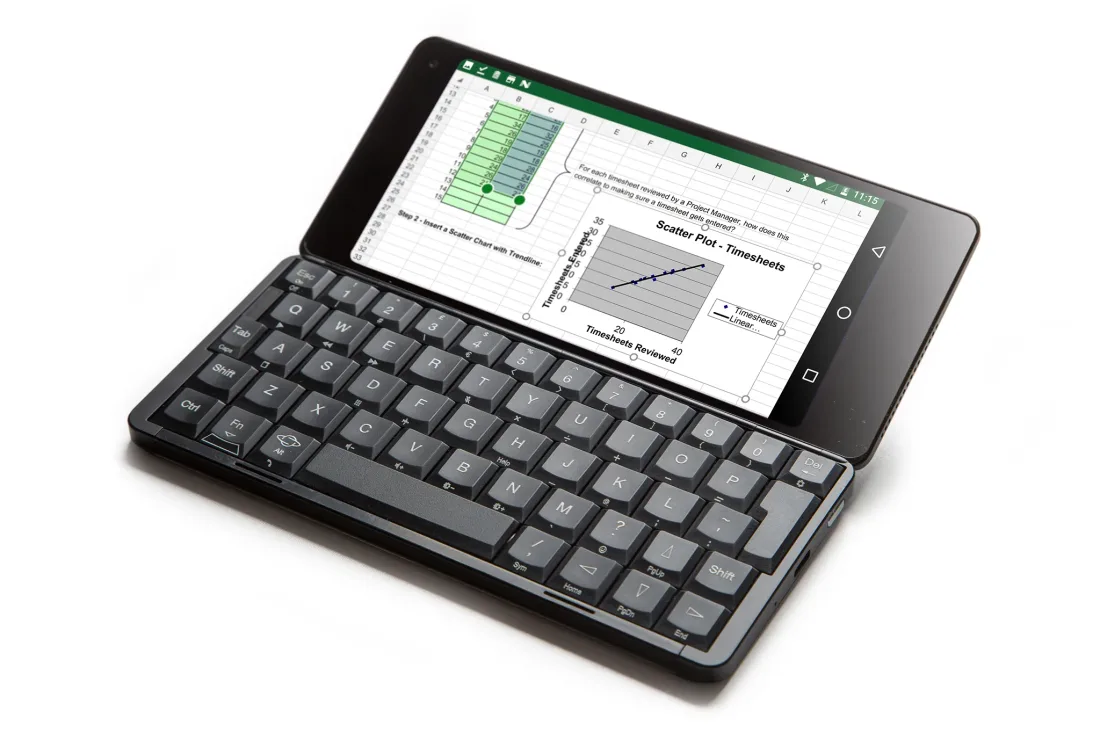
In 2017 Planet Computers decided to take exactly that path again, and it brought in Martin Riddiford himself for the design of the Gemini PDA.
Not as an aesthetic quotation of the Psion. The project recovered the two fundamental ideas of those machines: hinge and physical keyboard. Riddiford was called precisely to reinterpret in a contemporary form the concept he had helped create in the nineties. And this is why, among all the strange portable machines that have come out over the years, the Gemini is the one that genuinely interests me.
The Gemini was a clamshell with a display of about 6 inches at 2160 by 1080, a MediaTek Helio X27, 4 GB of RAM, 64 GB of storage, microSD, a 4,220 mAh battery, and, in the cellular version, 4G connectivity. Above all it could be configured in multiboot with Android, Debian, Kali, and Sailfish OS.
In January 2018 Brad Linder of Liliputing tried some pre-production units at CES in Las Vegas. The interesting thing is that he was not describing a concept: Planet had actually managed to build that machine. Android worked as it would on a touch device, and the keyboard turned out, despite its small size, to be surprisingly usable. Debian, on the other hand, was still very rough: Xfce was not suited to touch, and Linder noted that to work seriously in Linux the natural thing would be to connect a mouse.
The curious thing is that, reading that review today, to me this is not necessarily a flaw.
I do not want to turn Debian into Android. If I open a terminal, use Vim, connect a USB-C Ethernet adapter, open a web administration panel, I can perfectly well accept that Linux behaves like Linux. In fact, that is exactly what I am looking for.
The other reviews describe a fascinating device, but an imperfect one
I also looked for later experiences, because stopping at CES 2018 would give an incomplete picture. And the keyboard is almost always the central point.
Jonathan Morris, after a few weeks with the Gemini, openly described it as the realization of the idea of a modern Psion, and he considered the keyboard precisely what set it apart from the attempts to add a few keys to a smartphone. The 4G version he had tried also allowed phone calls and offered LTE.
A review by the Society for Computers & Law was more critical: the physical keyboard remained much better than a virtual one, but it did not reach the speed and comfort of the old Psion Series 5.
In 2020 Roar News praised instead the build, the metal structure, and the solidity of the hinge, while pointing out several compromises: by now dated hardware, a mediocre camera, unmemorable speakers, and some problems with keyboard consistency, the space bar included on the unit tested.
It is exactly the kind of flaw I would expect from a product like this. The Gemini does not come from the industrial scale of Apple, Samsung, or Lenovo. It is a niche machine attempting something that almost no other manufacturer had an economic interest in attempting.
And Debian? Here we have to be precise
This is the part that interests me most of all, and about which I would avoid any easy enthusiasm.
Planet published tools and firmware to install Debian on the Gemini, and the official support foresaw Android and Linux configurations in multiboot. But this does not mean that the Gemini is like taking a normal ThinkPad, installing Debian, and having everything supported by the mainline kernel.
The early Linux experiences described a system still tightly bound to the Android and MediaTek kernel, with hardware support not perfectly integrated. Jonathan McDowell, in 2018, did not consider Debian a true first class citizen of the device, and did not take for granted that LTE worked directly under Linux.
In the following years the community did document configurations with 4G working under Debian. Technically, then, you can get there.
The matter of phone calls directly from Debian is a different one. There have been experiments and discussions about using oFono and other Linux components to govern the telephony side, but I cannot find enough evidence to consider Debian telephony on the Gemini a ready, reliable function, comparable to the one available under Android.
For my use this would be one of the fundamental tests. The situation I would want is trivial: I insert a SIM, I start Debian, and the device stays both a computer and a phone. I do not want to have to boot Android to be reachable. If to make a call I had to switch operating systems, much of the charm of the experiment would disappear.
And the dream of the single USB-C?
Here comes another important point.
The Gemini has two USB-C ports and can use external peripherals, hubs, Ethernet, keyboard, mouse, and monitor. Some reviewers actually used it in this configuration. But I would not take for granted the behavior of a modern docking station with a single cable.
The documentation and the tests of the time indicate different roles for the two ports: the right one is used for video output through a specific USB-C to HDMI adapter from Planet, while the other handles the connection to the computer, charging, and peripherals. Planet still sells a dedicated HDMI cable that uses precisely the right port.
In other words, monitor plus Ethernet plus power plus peripherals through a normal USB-C dock and a single cable is one of the things I would like to verify in person before considering the Gemini a real replacement for the ThinkPad. On paper the concept is the right one, but not everything we take for granted today in the USB-C world was equally standardized in this machine from 2018.
So would I buy a Gemini PDA today?
Here I have to add a fundamental clarification: I have never tried a Gemini PDA in person.
This article is not a review of the Gemini. I cannot say the keyboard is comfortable for me, I cannot say Debian is reliable enough for my work, I cannot guarantee 4G under Linux, and above all I cannot claim that it would really replace the ThinkPad I carry with me every day.
I can, however, say that I would very much like to try it. Because, as an idea, it is perhaps the only device that answers the question that interests me. Not "how do I make a smartphone more productive?", but "how do I make a computer pocket sized?". It is a huge difference.
The rest has to be said too. The Gemini was born in 2018, and the 4G model is now sold out on Planet Computers' official store; the Wi-Fi one remains in the catalog, while Planet later developed the Cosmo Communicator and the Astro Slide 5G. In 2026, then, the Gemini would not be a normal purchase. It would in all likelihood be a device to look for on the used market, to buy knowing that you are entering a niche ecosystem, with dated hardware and quite a lot of potential work to do on the software.
But perhaps this is exactly the point.
The only real alternative, at least as an idea
There are mini laptops. There are Linux phones. There are foldable Bluetooth keyboards. There are smartphones that can be connected to an external monitor. But these are solutions that assemble components.
The Gemini starts instead from a form of use. You close the machine and it disappears. You open it and a keyboard appears. You set it down and it becomes a small computer. It is the same difference there was in the Psion Series 5: the hardware suggests to you what you can do.
For this reason, in my specific case, I consider the Gemini PDA the only option I would feel like experimenting with. Not because it is the technically best device of 2026, which it obviously is not. Not because it has the fastest CPU, the best display, the most up to date operating system. But because it is one of the very few recent products to have tried to pick up that path interrupted at the end of the nineties: building a personal computer starting from how it should be used, instead of building yet another rectangle of glass and letting the apps decide what it will become.
Maybe we asked the wrong question
Looking at a Psion Series 5 today, it is easy to fall into nostalgia. "Things used to be made better." I do not think that is the point.
A contemporary iPhone is technologically incomparable to a Psion. It would be ridiculous to argue the opposite. What I miss is the design freedom of that era.
The Psion was not afraid of being thick. It was not afraid of having a keyboard. It was not afraid of moving parts. It was not afraid of being different from a phone. Its design was born from the work it was meant to let you do.
And it is extraordinary that a mechanism conceived almost thirty years ago by Martin Riddiford continues to feel more intelligent and surprising than that of most of the devices we use every day.
The Gemini PDA tried to pick up that legacy directly. I do not yet know whether it would work for me. I would like to find out. I would like to get a Gemini 4G, install Debian, configure the modem, put my SIM in it, spend a whole day with just that, and see what happens. Then arrive at the office. Set it down on the desk. Connect network, monitor, and mouse to it. Open a terminal. And find out whether I can finally leave the ThinkPad at home.
If it worked, it would not just be a return of the PDA. It would be the return of an idea we have almost forgotten: a personal computer does not necessarily have to be a screen on which to install applications. It can still be a machine designed around the person who has to use it.
And perhaps this is exactly what makes the Psion Series 5 still so fascinating. Not the nostalgia. The fact that, after thirty years, that path still seems unexplored.