Bringing the most powerful model home is not impossible. It is just absurd
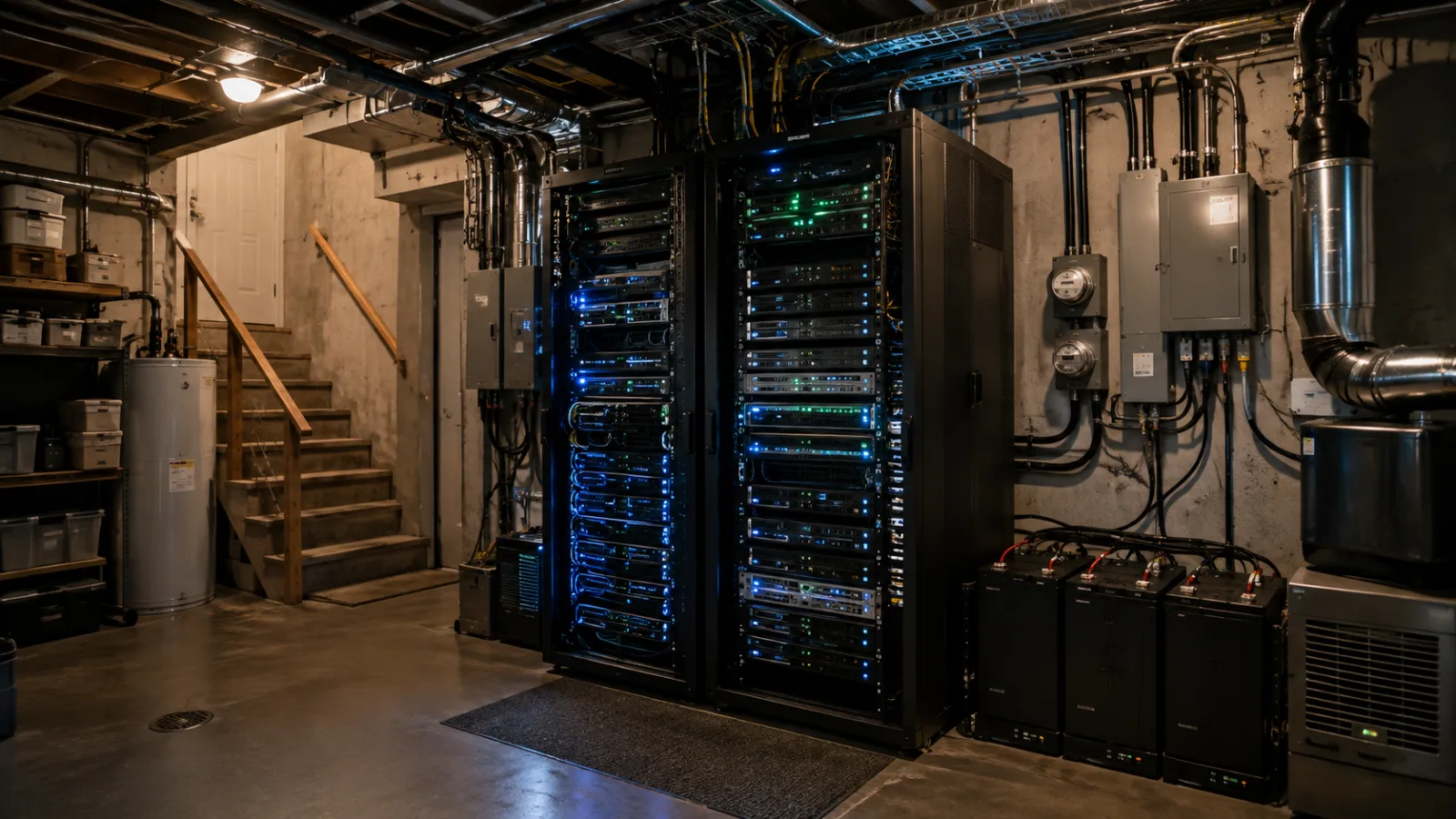
Let us make one thing clear right away, because otherwise this article gets read for what it is not.
What follows is a game. It is not a project, it is not a quote, it is not a proposal, and it does not describe any real case. It is a thought exercise with a single question: if we really wanted the most powerful model available, all to ourselves, inside our own home, at the maximum of its capabilities and with no compromises, what exactly would it take?
The purpose is not to sell anything. It is to measure a distance. Because in tech bar talk the phrase "I will just run it locally" is uttered with the same lightness with which people talk about installing a program, and it is worth seeing in black and white how far that goal is from a private individual or a small business.
Let us anticipate the answer: very far. But the way in which it is far is more interesting than the mere fact that it is.
The rules of the game
Three, and they are deliberately extreme.
The whole model. No reduced versions, no distillations, no compromises on quality. We take Kimi K3 as it is: a Mixture of Experts with 2.8 trillion total parameters, of which about 104 billion active per token, with the official weights in MXFP4 format.
Everything at home. No API, no cloud, no piece of the reasoning that leaves through the door. This is the point that makes the exercise interesting: it is exactly what people want when they say "I want it local".
At the maximum of its capabilities. Not the minimum configuration that gets it started, but the one that really makes it run, long context included.
With these rules, the reference machine is an NVIDIA B300 node with eight GPUs, in the commercial form of the DGX B300, which has the merit of having public specifications.
The object of desire
| Feature | Value |
|---|---|
| GPU | 8 × NVIDIA B300 |
| Total HBM memory | about 2.3 TB |
| Aggregate HBM bandwidth | about 64 TB/s |
| System RAM | 2 TB |
| NVMe storage | 30.72 TB |
| Height | 10U |
| Weight | about 168 kg |
| Maximum consumption | 14.5 kW |
| Heat produced | about 49,500 BTU/h |
Three of these rows already tell you where we are heading. It weighs as much as two adults. It draws as much as several apartments put together. And it converts into heat practically all the energy it consumes, because a computer produces nothing else.
The good news: the model fits
This is the only part of the exercise where the answer is clean, and it deserves to be said because it is genuinely remarkable.
Storing 2.8 trillion parameters at 4 bits requires about 1.4 TB. The node's 2.3 TB of high bandwidth memory therefore leave about 900 GB for everything else: quantization scales, buffers, conversation caches, communication between the GPUs, kernel working space.
The model fits in a single machine. Until recently a size like this would have required a cluster, with everything that entails in terms of networking and complexity. That today it fits in a single cabinet is the real technical change of the last two years, and it is the reason the exercise makes sense instead of being science fiction.
Beware, though, of the trap hidden in here. The fact that the model fits does not tell you how many users it serves. These are two different questions, and only the first is answered with a multiplication. And the million token window the model declares is not a million tokens for everyone at once: long context is occupied memory, and the memory occupied by one conversation is memory taken away from all the others.
Then begins the part nobody talks about
Up to here it looked like a purchase. From here on it becomes a construction site.
Twelve power cables. It is not a quirk: they are twelve 3.2 kW power supplies for a maximum load of 14.5 kW, to be split across two independent electrical lines, six and six, each able to carry the entire load on its own if the other fails. With the rest of the cabinet you reach 16 kW continuous, which calls for an uninterruptible power supply of at least 30 kVA. It is a permanent three phase load to be designed, not a plug to stick into an industrial socket.
Twenty kilowatts of cooling. Those 14.5 kW of electricity come out as 49,500 BTU/h of heat, twenty four hours a day. You need a precision system, a cold aisle separated from the hot one, sensors front and back, water leak detection, early smoke detection. The living room air conditioner is out of the question: it is not a matter of power, it is that it is not designed never to stop.
Three hundred kilos on the floor. Between the server, the cabinet, the distribution unit, and the cables you comfortably exceed 300 kg, and the floor has to be checked not only for the total weight but for the load concentrated on the four feet. In an apartment this sentence sounds different than in a warehouse.
The bill for the game
| Item | Indicative amount |
|---|---|
| Server with 8 B300 GPUs | 535,000 · 714,000 € |
| High speed switch | 65,000 · 85,000 € |
| Cables, cabinet, distribution, sensors | 8,000 · 18,500 € |
| Uninterruptible power supplies and dual line | 30,000 · 50,000 € |
| Precision cooling | 25,000 · 60,000 € |
| Electrical and fire safety upgrades | 15,000 · 50,000 € |
| Integration, transport, contingency | 30,000 · 80,000 € |
| Total | about 708,000 · 1,057,500 € |
A prudent figure for the complete game is around 750,000 · 900,000 euros, VAT excluded.
Then there is the electricity bill, which is the part that never shows up in bar talk. Sixteen continuous kilowatts make 140,160 kWh a year. With cooling and losses you reach 175 · 189 MWh, that is, between 35,000 and 57,000 euros a year at current prices. With maintenance, spare parts, batteries, and staffing you head toward 50,000 · 90,000 euros a year.
Put in a more physical way: almost a megawatt hour every five days, inside a single cabinet.
How far away it is, in practice
Now for the part we did all this for.
For a private individual, the comparison is not even with a computer. A typical Italian domestic supply is 3 kW, 6 at most. This machine, on its own, asks for more than double the maximum, three phase, continuously. It is not that it costs too much: it is that the house does not have the socket. And even if it did, there would still be the 16 kW of heat to throw out all year and the three hundred kilos to set down somewhere. The distance is not economic, it is physical.
For a small business the discussion changes shape but not outcome. The warehouse has the power, the floor holds, the technical room can be carved out. The problem becomes another one: 800,000 euros of investment plus 70,000 a year of operation make sense only if spread over a number of users that a small or medium company does not have. Spread over four years and twenty thousand active users, the cost drops below fifteen euros a head per year and becomes reasonable. Spread over twenty people, it is five thousand euros a year per employee to have a model that, via API, would cost a fraction.
The threshold, in short, is not technological. It is one of scale. And the scale needed is not that of a company: it is that of a service provider.
Why the game is useful anyway
An exercise like this does not serve to discourage anyone. It serves three very concrete purposes.
First, to understand what you are asking for when you say "I want it local". Almost always you are not asking for the most powerful model in the world: you are asking that certain data not leave. These are two different desires, and the second is satisfied with much smaller means.
Second, to recognize where the line runs. Below a certain scale, an external provider's API costs a fraction and asks for nothing but trust. Above it, the ratio flips. Knowing which side of the line you are on is more useful than any quote.
Third, to put the promises in perspective. Nobody can say how many users a machine like this serves by looking at the spec sheet: it depends on the length of the requests, on how many arrive at once, on the runtime, on the available kernels. Anyone who promises a number of tokens per second before having run the real prompts is guessing, and that holds for this machine as for any other.
The most powerful model in the world, today, physically fits in a cabinet. That is the news. That the cabinet requires a three phase installation, industrial cooling, and the budget of a house in the city center is the reason why, for now, it remains a game.
But it is a game worth having played once, because the boundary moves every year. The math redone in three years will give a different number, and on that day the question will turn serious again.